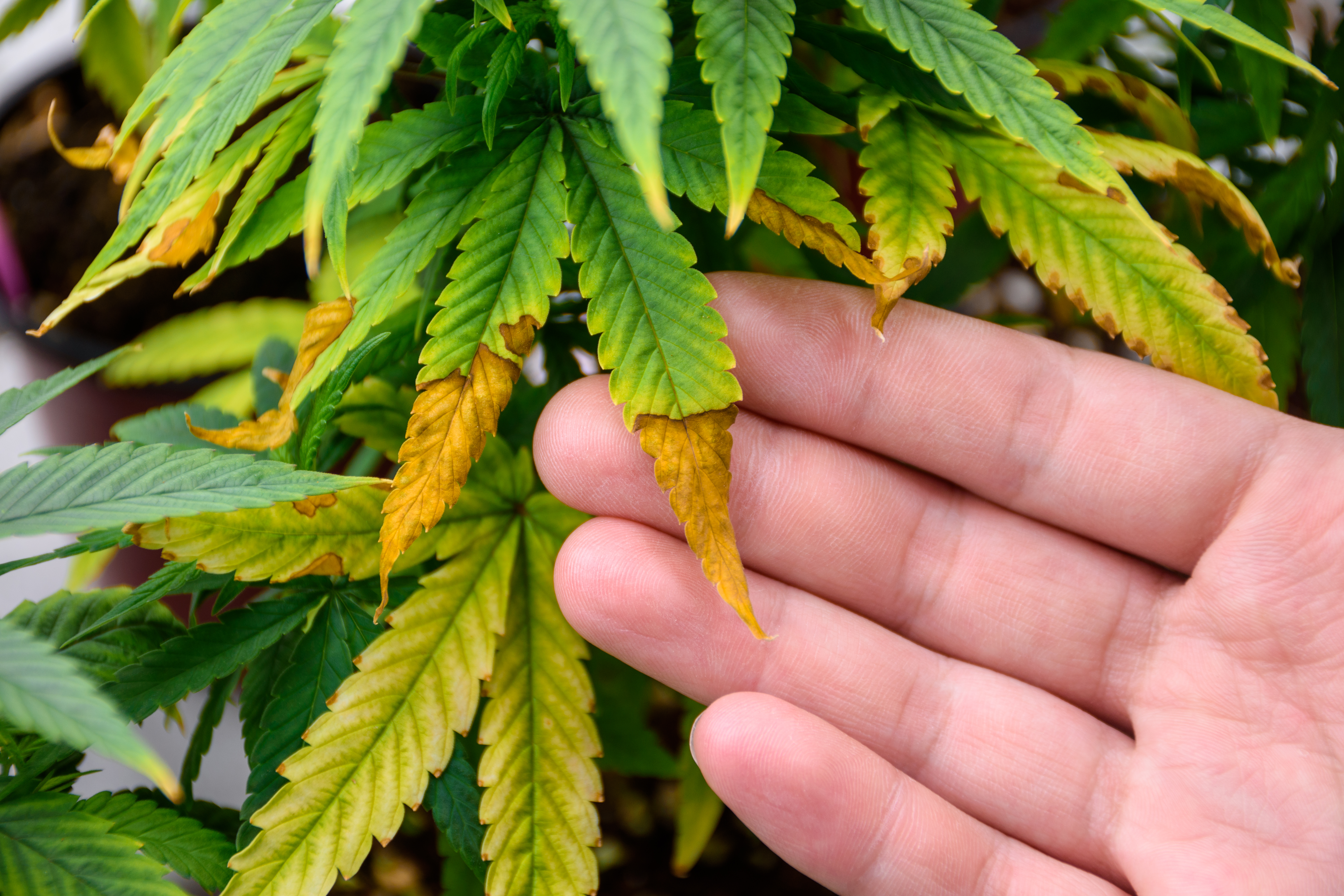


Nitrogen deficiency is one of the most common nutrient problems seen in weed plants. It happens when a plant does not get enough usable nitrogen to support normal growth. Nitrogen is an important plant nutrient because it helps support healthy leaves, stems, and overall plant development. When nitrogen becomes limited, the plant often begins to show clear signs, especially in its older leaves.
One of the first signs of nitrogen deficiency is a change in leaf color. Healthy leaves are usually green because they contain chlorophyll. Chlorophyll is the green pigment that helps plants capture light for photosynthesis. Nitrogen plays an important role in the production of chlorophyll. When a plant does not have enough nitrogen, it may not be able to maintain normal chlorophyll levels. As a result, leaves can begin to turn pale green and then yellow.
The yellowing caused by nitrogen deficiency often starts on the older leaves near the bottom of the plant. This happens because nitrogen is considered a mobile nutrient. A plant can move nitrogen from older leaves to younger leaves when supplies are low. The plant does this to protect new growth, which is often more important for continued development. Because of this movement, lower leaves may lose their green color first while the leaves near the top stay green for a longer time.
As the deficiency becomes more serious, yellowing can spread upward through the plant. Older leaves may become completely yellow, dry out, or fall from the plant. Growth may also become slower. Stems and new leaves may develop less strongly than expected. If the problem continues for too long, the plant may have difficulty maintaining normal growth.
Nitrogen is especially important during the vegetative stage. During this part of the growth cycle, plants focus heavily on producing leaves, branches, and stems. These structures create the base that supports later development. Since nitrogen is closely linked to green tissue and plant growth, a lack of nitrogen during this stage can become noticeable fairly quickly.
However, yellow leaves do not always mean that a plant needs more nitrogen. This is an important point to understand before trying to correct the problem. Several other issues can cause similar symptoms. Poor root health, incorrect watering, unsuitable root-zone pH, nutrient imbalance, and other deficiencies can also cause leaves to turn yellow.
In some cases, nitrogen may already be present in the growing medium, but the roots may not be able to absorb it properly. This is sometimes called nutrient lockout. For example, conditions around the roots can affect how easily nutrients become available to the plant. Simply adding more fertilizer may not solve the problem if the real cause is related to the root environment.
Adding too much nitrogen can also create problems. Plants need nitrogen, but more is not always better. Excess nitrogen can cause very dark green leaves, weak nutrient balance, and other stress symptoms. For this reason, it is important to identify the likely cause of yellowing before making major changes to plant nutrition.
The growth stage of the plant also matters. Yellowing during early vegetative growth can be more concerning because the plant depends heavily on nitrogen at that time. Yellowing later in the plant’s life cycle may have a different meaning. Some older leaves naturally lose color as the plant ages. Because of this, the location of the yellow leaves, how quickly the symptoms develop, and the stage of growth all need to be considered together.
Early observation can make nitrogen-related problems easier to understand. A small change in the lower leaves may be easier to evaluate than severe yellowing across much of the plant. Checking plants regularly can help growers notice changes before they become widespread. It is useful to look at leaf color, growth rate, watering conditions, and the general health of the root zone rather than focusing on only one symptom.
It is also important to watch how symptoms develop over time. A single yellow leaf does not always mean there is a serious deficiency. Older leaves can become damaged for many reasons. A more useful warning sign is a clear pattern, such as several older leaves becoming pale or yellow while newer growth remains greener. If that pattern continues to move upward, a nitrogen problem becomes more likely.
Understanding nitrogen deficiency is therefore not only about knowing that yellow leaves can be a warning sign. It also means understanding how nitrogen works inside the plant, why symptoms usually begin on older growth, and why other problems can sometimes look similar. Correct identification helps reduce the risk of unnecessary feeding or other changes that may create additional stress.
This guide will explain the main signs and causes of nitrogen deficiency, how it differs from other plant problems, and what factors should be checked when symptoms appear. It will also cover how nitrogen needs can change during different stages of growth, what recovery may look like, and how good nutrient and root-zone management can reduce the chance of similar problems in the future. By learning to recognize the full pattern of nitrogen deficiency, growers can make more informed decisions instead of reacting to yellow leaves alone.
What Does Nitrogen Do for Weed Plants?
Nitrogen is one of the most important nutrients for weed plants. It is known as a primary macronutrient because plants need it in larger amounts than many other nutrients. Nitrogen is especially important during the vegetative stage, when a weed plant is focused on producing leaves, stems, branches, and roots.
Growers often see nitrogen listed as the first number in the N-P-K ratio on fertilizer labels. N-P-K stands for nitrogen, phosphorus, and potassium. These are the three main nutrients that plants need in significant amounts. Each nutrient has a different role, but nitrogen is closely linked to green growth and overall plant development.
A weed plant with enough nitrogen usually has healthy green leaves and steady growth. When nitrogen becomes too low, older leaves may start to lose their green color. Growth can also slow down because the plant has less nitrogen available for basic processes such as photosynthesis and protein production.
Understanding how nitrogen works inside the plant makes it easier to recognize a deficiency. It also helps growers avoid the mistake of adding more fertilizer without first understanding what the plant needs.
Why Cannabis Needs Nitrogen
Nitrogen plays several major roles inside a weed plant. One of its most important jobs is helping the plant produce chlorophyll. Chlorophyll is the green pigment found in leaves. It helps the plant capture light and use that energy during photosynthesis.
Photosynthesis allows a plant to turn light, water, and carbon dioxide into energy that supports growth. When a plant does not receive enough nitrogen, it may not produce enough chlorophyll. This is one reason nitrogen deficiency often causes leaves to become pale green and then yellow.
Nitrogen is also needed to produce amino acids. Amino acids are building blocks for proteins. Plants use proteins for many important functions, including cell growth, tissue repair, and enzyme activity. Without enough nitrogen, the plant may struggle to create the materials it needs for strong and healthy development.
The nutrient is also part of nucleic acids, including DNA and RNA. These compounds carry genetic information and help control how cells grow and divide. New growth requires active cell production, so a good nitrogen supply is important when a plant is developing quickly.
Nitrogen also supports the growth of leaves and stems. During the vegetative stage, weed plants often grow rapidly. They may develop large fan leaves, new branches, and thicker stems. These structures help create a larger canopy that can capture more light.
Because of this rapid development, nitrogen demand is usually higher during vegetative growth than it is during the later stages of flowering. A plant that does not receive enough nitrogen during this period may grow more slowly. Leaves may become smaller, stems may appear weaker, and the plant may have difficulty building a strong structure before flowering begins.
However, more nitrogen is not always better. Too much nitrogen can also cause problems. A plant receiving excessive nitrogen may develop very dark green leaves and weak or abnormal growth. This is why growers should aim for balanced nutrition instead of simply increasing nitrogen whenever a plant looks unhealthy.
Nitrogen needs also change during the plant’s life cycle. Young seedlings need nutrients, but they usually need lower amounts than large vegetative plants. As growth speeds up, nutrient demand rises. Once flowering begins, the balance of nutrients changes again.
The plant still needs some nitrogen during flowering, especially during the early stages, but its needs may decrease as it focuses more energy on flower development. Cutting nitrogen too quickly can cause an early deficiency, while keeping nitrogen levels too high can create other nutrient problems.
How Nitrogen Moves Through the Plant
Nitrogen is considered a mobile nutrient. This means the plant can move nitrogen from one part of its tissues to another when supplies become limited.
This movement is an important part of understanding nitrogen deficiency. When there is not enough nitrogen available through the roots, the plant tries to protect its newest growth. It can take nitrogen stored in older leaves and move it toward younger leaves and growing areas.
Older leaves are usually found lower on the plant. Because the plant removes nitrogen from these leaves first, they often become pale green before the upper leaves show any major changes.
As the deficiency continues, lower leaves may turn completely yellow. Some may eventually dry out, develop brown areas, or fall from the plant. Meanwhile, the newer leaves near the top may stay green for a longer period.
This pattern is one of the main clues growers use when checking for nitrogen deficiency. A problem that starts with older leaves and slowly moves upward is more consistent with a mobile nutrient deficiency than a problem that begins only in new growth.
The plant moves nitrogen because young tissues are more important for continued growth. New leaves are still developing and are often more active than older leaves. By moving nutrients toward these areas, the plant can continue growing for a limited time even when the root zone is not providing enough nitrogen.
This process can help the plant survive short periods of low nutrient availability. However, it cannot continue forever. If the plant does not receive enough nitrogen for an extended period, more leaves will lose their green color and growth may slow significantly.
The speed at which symptoms develop can vary. A mild shortage may cause gradual yellowing over several days or longer. A more serious problem may spread more quickly, especially when a large plant is growing rapidly and has a high nutrient demand.
It is also important to remember that yellow lower leaves do not always prove that the plant needs more fertilizer. Nitrogen may already be present in the soil or nutrient solution but may not be available to the roots. Incorrect pH, damaged roots, poor drainage, or other root-zone problems can interfere with nutrient uptake.
For this reason, growers should look at the complete pattern of symptoms before treating the plant. The location of yellow leaves, the stage of growth, the feeding schedule, root-zone conditions, and pH can all provide useful information.
Nitrogen is a key nutrient that supports green leaves, photosynthesis, protein production, cell growth, and strong vegetative development. Weed plants usually need more nitrogen while they are building leaves, stems, and branches during the vegetative stage.
Nitrogen is also a mobile nutrient. When supplies become low, the plant can move nitrogen out of older leaves and send it toward younger growth. This is why nitrogen deficiency normally begins with pale or yellow leaves near the bottom of the plant and may slowly move upward if the problem continues.
What Does Nitrogen Deficiency in Weed Look Like?
Nitrogen deficiency is one of the easier nutrient problems to recognize in cannabis because it often follows a clear pattern. The first signs usually appear on the oldest leaves near the bottom of the plant. These leaves may slowly lose their deep green color and become pale green or yellow. As the problem becomes more serious, the yellowing can move upward toward newer parts of the plant.
The key is to look at where the symptoms begin and how they spread. Many plant problems can cause yellow leaves, but nitrogen deficiency usually affects older growth first because nitrogen is a mobile nutrient. This means the plant can move nitrogen from older leaves to areas where it is needed more, such as new leaves and growing shoots.
Understanding this pattern can help growers tell nitrogen deficiency apart from other nutrient problems, watering issues, or normal changes that happen as the plant matures.
Early Symptoms of Nitrogen Deficiency
One of the first signs of nitrogen deficiency is a change in the color of older fan leaves. Healthy cannabis leaves are usually medium to deep green. When nitrogen becomes limited, the lower leaves may become lighter green before turning yellow.
The color change is often gradual. A leaf may first look slightly faded compared with the leaves higher on the plant. Over time, the whole leaf may become pale. In many cases, the yellowing looks fairly even across the leaf instead of appearing as spots, stripes, or damaged edges.
Another important sign is the location of the yellow leaves. Early nitrogen deficiency usually starts near the bottom of the plant. This happens because the plant moves available nitrogen from older leaves into newer growth.
During the early stages, new leaves near the top of the plant may still look healthy and green. This difference between the older leaves and the newer leaves can be an important clue.
Plant growth may also begin to slow. Nitrogen plays an important role in leaf development and photosynthesis, so plants with low nitrogen may not grow as quickly as healthy plants. Stems may appear thinner, and the plant may produce less new leaf growth.
These early symptoms are easier to manage when they are noticed before the condition becomes severe. However, yellow lower leaves alone do not prove that a plant has a nitrogen deficiency. Growers should also consider the plant’s growth stage, watering conditions, root health, and nutrient program.
Advanced Symptoms of Nitrogen Deficiency
If the plant continues to receive too little available nitrogen, the symptoms may become more obvious. Yellowing can spread from the oldest leaves toward the middle of the plant.
Lower leaves may eventually turn completely yellow. As the condition progresses, some leaves may become dry, brittle, or brown. Severely affected leaves can curl, weaken, and fall from the plant.
The plant may also lose its normal vigor. New growth can become slower, and the plant may appear smaller than expected for its age. Branches may develop more slowly because the plant does not have enough nitrogen to support strong vegetative growth.
In serious cases, a large part of the lower canopy may become yellow. The plant may begin using stored nutrients faster than they can be replaced. This can reduce the amount of healthy leaf tissue available for photosynthesis.
Leaf loss is another possible sign of advanced deficiency. Once a leaf has become badly damaged, the plant may allow it to dry out and fall away. A few damaged lower leaves do not always mean the entire plant is in danger, but widespread yellowing that continues to move upward should be investigated.
It is also important to remember that damaged leaves may not fully recover their original green color. Once a leaf has become heavily yellowed or dry, it may remain damaged even after the main problem has been corrected. For this reason, changes in newer growth can provide a better picture of whether the plant’s condition is improving.
Where Symptoms Usually Appear First
The location of yellowing is one of the strongest clues when identifying nitrogen deficiency. Symptoms usually begin on older fan leaves near the bottom of the cannabis plant.
This pattern happens because nitrogen is mobile inside plant tissue. When the roots cannot supply enough nitrogen, the plant can move some of the nitrogen stored in older leaves to younger leaves and growing areas.
The plant gives priority to new growth because these areas are important for continued development. As nitrogen leaves the older foliage, those leaves lose chlorophyll. Chlorophyll is the green pigment plants use to capture light for photosynthesis. When chlorophyll levels fall, the leaves become pale and eventually yellow.
As the shortage continues, the yellowing may slowly move upward. Leaves in the middle of the plant may begin to fade after the lowest leaves have already turned yellow.
This bottom-to-top pattern helps separate nitrogen deficiency from some other nutrient problems. Certain deficiencies affect new growth first because those nutrients cannot move easily from older leaves to younger tissue. Others may create spots, burned margins, or yellow areas between the veins instead of causing an even loss of green color.
The plant’s stage of growth also matters. Yellow lower leaves during active vegetative growth can be more concerning because cannabis normally needs a steady supply of nitrogen during this stage. Some yellowing later in the plant’s life cycle may have different causes and should not automatically be treated as a nitrogen shortage.
Nitrogen deficiency in weed plants usually begins with older leaves near the bottom of the plant becoming pale green and then yellow. The color change is often fairly even across the leaf, while younger growth stays green during the early stages.
If the problem continues, yellowing may spread upward. Older leaves can become dry, brown, weak, and eventually fall from the plant. Overall growth may also slow because nitrogen is important for chlorophyll production, photosynthesis, and healthy leaf development.
The bottom-up pattern is especially useful when identifying nitrogen deficiency. Because nitrogen is a mobile nutrient, the plant can move it from older leaves to newer growth when supplies are limited. However, yellow leaves can have several causes, so growers should consider the full symptom pattern before deciding that nitrogen deficiency is the problem.
What Causes Nitrogen Deficiency in Weed Plants?
Nitrogen deficiency can happen for several reasons. In some cases, the growing medium simply does not contain enough nitrogen. In other cases, nitrogen is present, but the roots cannot absorb it well. Problems with pH, watering, root health, and feeding schedules can all affect how much nitrogen reaches the plant.
Finding the real cause is important before adding more fertilizer. If a grower assumes that every yellow leaf means the plant needs more nitrogen, the problem can become worse. Adding extra nutrients to a plant that already has enough nitrogen can lead to nutrient burn, salt buildup, or nitrogen toxicity.
The best approach is to look at the whole growing environment. Check the feeding schedule, root-zone conditions, pH, watering habits, and the plant’s stage of growth. These factors can help explain why a nitrogen deficiency developed.
Not Enough Nitrogen in the Growing Medium
One of the simplest causes of nitrogen deficiency is a lack of nitrogen in the growing medium. Cannabis plants use nitrogen as they grow, especially during the vegetative stage when they are producing large amounts of leaves and stems.
If the soil or other growing medium does not contain enough available nitrogen, the plant may begin taking nitrogen from its older leaves. This is why lower fan leaves often start turning pale green and then yellow.
Underfeeding is one common reason this happens. A grower may use less fertilizer than the plant needs or wait too long between feedings. Young plants may grow well with a mild nutrient solution, but their needs increase as they become larger. A feeding level that worked earlier may no longer provide enough nitrogen.
The type of fertilizer also matters. Some nutrient products contain more nitrogen than others. A fertilizer designed for flowering plants may contain less nitrogen because flowering plants usually need different nutrient ratios than plants in the vegetative stage. Using a low-nitrogen bloom formula too early may cause a shortage.
Soil can also become depleted over time. Organic matter and nutrients are slowly used by the plant. If the growing medium is reused or has not been amended properly, nitrogen levels may become too low to support healthy growth.
However, low nitrogen in the soil is only one possible cause. A plant may show signs of deficiency even when enough nitrogen is present.
Incorrect pH and Nutrient Lockout
Root-zone pH affects how well cannabis plants can absorb nutrients. When pH moves too far outside the suitable range for the growing medium, some nutrients become harder for the roots to take up.
This problem is often called nutrient lockout. Nitrogen may still be present in the soil, coco, or nutrient solution, but the plant may not be able to use it efficiently.
A grower may respond by adding more nitrogen. This can create an even larger nutrient imbalance because the unused nutrients remain in the growing medium. Over time, salts can build up around the roots and make nutrient uptake even more difficult.
Checking pH is therefore an important step before increasing fertilizer levels. The ideal range can vary depending on whether the plant is grown in soil, coco, or a hydroponic system. What matters most is keeping the root zone within a stable range that allows nutrients to remain available.
Sudden pH changes can also cause problems. Even if the average pH seems acceptable, large swings can stress the roots and affect nutrient uptake. A stable root environment makes it easier for the plant to access nitrogen and other essential nutrients.
Root and Watering Problems
Healthy roots are needed for healthy nutrient uptake. When roots are stressed or damaged, the plant may struggle to absorb nitrogen even when enough is available.
Overwatering is one common cause of root stress. Roots need both water and oxygen. If the growing medium stays wet for too long, there may not be enough oxygen around the root zone. This can reduce root activity and slow nutrient absorption.
Poor drainage can create the same problem. Heavy soil, blocked drainage holes, or containers that hold too much water may keep roots constantly wet. Over time, unhealthy root conditions can cause yellowing, slow growth, and other symptoms that look similar to nutrient deficiencies.
Root damage can also come from disease, physical injury, or poor growing conditions. Damaged roots have less ability to take up water and nutrients. When this happens, adding stronger fertilizer may not solve the problem.
Salt buildup is another concern. Repeated feeding can cause unused mineral salts to collect in the growing medium. High salt levels can interfere with the plant’s ability to absorb water and nutrients. This may lead to symptoms of nitrogen deficiency even though nitrogen is present.
Before increasing nitrogen, growers should consider whether the roots are healthy, whether the medium drains properly, and whether the plant is being watered too often.
Growth Stage and Feeding Changes
Cannabis plants do not need the same amount of nitrogen during every stage of growth. Nitrogen demand is usually higher during the vegetative stage because the plant is building leaves, branches, and stems.
During flowering, nutrient needs begin to change. Growers often switch from vegetative nutrients to a bloom formula with lower nitrogen and higher levels of other nutrients.
Problems can occur when this change happens too quickly. Cutting nitrogen too early may leave the plant without enough to support the first part of flowering. Cannabis plants continue to stretch and grow during the transition into bloom, so they still need some nitrogen.
A sudden reduction in nitrogen can cause lower leaves to turn yellow earlier than expected. If the deficiency becomes severe, yellowing may move upward through the plant and overall growth may slow.
On the other hand, some yellowing late in flowering can be part of the plant’s natural aging process. This is why growth stage should always be considered before treating yellow leaves as a deficiency.
Feeding programs should be adjusted gradually when possible. The goal is to provide enough nitrogen for healthy growth without supplying so much that the plant develops dark green leaves, clawing, or other signs of excess nitrogen.
Nitrogen deficiency in weed plants is not always caused by a simple lack of fertilizer. Low nitrogen in the growing medium can cause the problem, but pH imbalance, nutrient lockout, root damage, overwatering, poor drainage, and salt buildup can produce similar symptoms. Sudden changes in feeding during the shift from vegetative growth to flowering may also lead to nitrogen shortages.
How Can You Tell Nitrogen Deficiency From Other Problems?
Yellow leaves do not always mean a weed plant has a nitrogen deficiency. Many plant health problems can cause similar changes in leaf color. Watering problems, other nutrient shortages, excess fertilizer, and normal aging can all make leaves turn yellow or brown.
Because several problems can look alike, it is important to study where the symptoms first appear and how they spread through the plant. A true nitrogen deficiency usually starts with older leaves near the bottom of the plant. These leaves slowly become lighter green and then yellow. If the problem becomes more serious, the yellowing can move upward toward younger growth.
Looking at the whole plant rather than one damaged leaf can make diagnosis easier. Leaf patterns, plant age, growth stage, and other symptoms can all provide useful clues.
Nitrogen Deficiency vs. Magnesium Deficiency
Nitrogen and magnesium deficiencies can both cause yellow leaves, especially on older growth. However, the pattern of yellowing is usually different.
With nitrogen deficiency, the entire leaf often becomes pale or yellow in a fairly even way. The change may begin near the lower part of the plant and gradually affect more leaves. Older leaves may eventually dry out and fall from the plant if the problem continues.
Magnesium deficiency often creates a different pattern called interveinal chlorosis. This means the tissue between the leaf veins becomes yellow while the veins themselves remain greener. The leaf can develop a striped or marbled appearance instead of turning evenly yellow.
Both nitrogen and magnesium are mobile nutrients. This means the plant can move them from older growth to newer growth when supplies are limited. Because of this, both problems can begin on older leaves.
The pattern on the leaf is one of the most useful clues. Even yellowing across most of the leaf points more strongly toward nitrogen deficiency, while yellow areas between green veins may suggest magnesium deficiency.
Nitrogen Deficiency vs. Potassium Deficiency
Potassium deficiency can also affect older leaves, which sometimes makes it difficult to tell apart from nitrogen deficiency during the early stages.
The biggest difference is often found around the edges of the leaves. Nitrogen deficiency normally causes a more general fading of the leaf. It may change from healthy green to pale green and then yellow.
Potassium deficiency is more likely to cause yellowing, browning, or damage near the leaf edges and tips. The edges may begin to look dry or scorched. As the problem becomes more severe, brown spots or dead sections may form around the margins of the leaf.
A plant with potassium problems may therefore have leaves that look burned around the outside while parts of the center remain greener. A plant lacking nitrogen usually shows a more even loss of green color.
Looking at several leaves can help. One damaged leaf may not give enough information. A repeating pattern across older leaves is much more useful when trying to identify the cause.
Nitrogen Deficiency vs. Nutrient Burn
Nitrogen deficiency and nutrient burn come from very different conditions. Nitrogen deficiency involves too little available nitrogen, while nutrient burn is commonly linked with excessive fertilizer levels.
The appearance of the leaves can help separate the two.
Nitrogen-deficient plants often become lighter in color. Older leaves may slowly fade from green to yellow before becoming dry or falling away.
Nutrient burn often begins at the tips of the leaves. The tips may turn yellow, brown, or dry while the rest of the leaf remains green. As the problem becomes worse, the damaged area can spread farther inward from the tip or edges.
Plant color can also provide clues. Too much nitrogen can make foliage unusually dark green. Leaves may sometimes curl downward or develop a hooked appearance. This is very different from the pale green or yellow color normally linked with nitrogen deficiency.
For this reason, adding more fertilizer simply because a plant has damaged leaves can make matters worse if excess nutrients are already the problem.
Nitrogen Deficiency vs. Overwatering
Overwatering can sometimes create symptoms that look like nutrient deficiency. Leaves may become pale, yellow, soft, or droopy. Plant growth may also slow.
The difference is that overwatering affects the root environment rather than simply reducing the amount of nitrogen available.
Roots need both moisture and oxygen. If the growing medium stays wet for too long, air spaces can remain filled with water. This can place stress on the roots. When roots are unhealthy, the plant may have trouble taking up nutrients even when those nutrients are present.
This means a plant can appear to have a nitrogen problem even though the growing medium contains enough nitrogen.
Leaf position can provide another clue. Overwatered plants may have several leaves drooping at the same time. The growing medium may also remain wet for long periods. Nitrogen deficiency is more often recognized by gradual yellowing that starts with older lower leaves.
It is also possible for more than one problem to happen at the same time. Poor root conditions can interfere with nutrient uptake and create symptoms that resemble several deficiencies.
Nitrogen Deficiency vs. Natural Flowering Fade
Growth stage is another important factor when judging yellow leaves.
During later stages of flowering, older leaves may naturally begin losing some of their green color. Plants change how they use nutrients as they mature, and older leaves can gradually yellow as part of normal aging.
This natural change can look similar to nitrogen deficiency.
The timing and speed of the yellowing can help separate the two. Gradual yellowing of some older leaves late in the plant’s life cycle may be part of normal senescence. This term describes the natural aging process of plant tissue.
Rapid yellowing much earlier in growth may be more concerning, especially if it spreads through many leaves and is combined with weak or slowed growth.
Growers should therefore avoid judging nitrogen status from leaf color alone. The plant’s age and stage of development are important parts of the picture.
Nitrogen deficiency can look similar to several other plant problems, so careful observation is important. True nitrogen deficiency commonly begins with older lower leaves that become pale green and then yellow in a fairly even pattern.
Magnesium deficiency is more likely to produce yellow areas between green veins. Potassium problems often damage the leaf edges and tips. Nutrient burn commonly begins with browned or burned tips and may occur alongside very dark green foliage. Overwatering can cause yellowing and drooping because stressed roots cannot function normally. Late in flowering, some yellowing may simply be part of natural plant aging.
How to Diagnose Nitrogen Deficiency Before Treating It
Yellow leaves do not always mean a weed plant needs more nitrogen. Several problems can cause similar symptoms, including poor pH, damaged roots, overwatering, salt buildup, or another nutrient deficiency. For this reason, diagnosis should come before treatment.
Nitrogen is a mobile nutrient. This means the plant can move stored nitrogen from older leaves to newer growth when supplies are low. As a result, a true nitrogen deficiency often starts on older leaves near the bottom of the plant. The yellowing may then move upward if the problem continues.
Before changing the feeding program, look at the whole plant and its growing conditions. The location of the yellow leaves, the growth stage, root-zone pH, feeding history, and watering habits can all provide useful clues.
Check Which Leaves Are Yellowing
Start by looking at where the symptoms first appeared. With nitrogen deficiency, older and lower leaves are normally affected before the young leaves near the top of the plant. This happens because the plant moves nitrogen from older tissue to areas that are still growing.
Early symptoms may begin as a general loss of green color. The lower leaves may look pale green at first and then become more evenly yellow. If the deficiency becomes more severe, the yellowing can spread to leaves higher on the plant. Older leaves may eventually dry out and fall.
Pay attention to the pattern of discoloration as well. Nitrogen deficiency often causes fairly even yellowing across much of the leaf. Other nutrient problems can create different patterns. For example, magnesium problems can cause yellow areas between greener veins, while potassium problems can cause damage around leaf tips and edges.
Do not diagnose a nitrogen problem based on one yellow leaf. Older leaves can naturally die as a plant grows. Instead, look for a pattern affecting several older leaves and watch whether the yellowing continues to spread.
Review the Plant’s Growth Stage
The plant’s stage of growth can help explain whether yellowing is unusual.
During vegetative growth, cannabis plants use nitrogen to build leaves, stems, and other green tissue. A plant that becomes pale and starts losing older leaves during this stage may have a problem with nitrogen supply or nutrient uptake.
The situation can be different during flowering. Nitrogen requirements change as the plant shifts from producing mainly leaves and stems to supporting flowers. Some yellowing of older foliage can occur later in the plant’s life cycle.
However, rapid yellowing during early flowering should still be investigated. A grower may reduce nitrogen too quickly after changing to a flowering nutrient formula. The plant can then begin using nitrogen stored in its older leaves faster than expected.
Growth stage should therefore be considered together with the speed and location of the yellowing. A few fading lower leaves late in the cycle are different from widespread yellowing on a young plant that should still be growing strongly.
Check Root-Zone pH
A plant can show deficiency symptoms even when nitrogen is present in the growing medium. One possible reason is incorrect pH.
Root-zone pH affects how easily nutrients can be taken up. When the pH becomes unsuitable, nutrient availability can fall. The plant may then show signs that look like underfeeding even though fertilizer has already been applied. This problem is often called nutrient lockout.
Check the pH of the water or nutrient solution as well as the growing medium when possible. Soil and hydroponic systems do not use exactly the same pH range, so growers should follow recommendations for their particular medium and nutrient product.
This step is important before adding more fertilizer. If poor pH is preventing nutrient uptake, adding extra nitrogen may not solve the problem. It can instead increase salt levels in the root zone and create more stress.
If pH is outside the desired range, correct that issue first and then monitor the plant. Healthier new growth after the root-zone conditions improve can be a sign that nutrient uptake is returning to normal.
Review the Feeding Schedule
Next, look at what the plant has been receiving.
Consider when it was last fed, which nutrient product was used, and whether the feeding strength recently changed. A plant may become nitrogen deficient if it has received too little fertilizer for an extended period or if the growing medium has become depleted.
A sudden change in nutrient formulas can also matter. For example, switching from a vegetative formula to one with much less nitrogen may cause symptoms if the plant still has a strong nitrogen demand.
At the same time, avoid assuming that stronger feeding is always better. Excess fertilizer can increase salts around the roots and interfere with nutrient uptake. In some cases, an overfed plant can develop symptoms that look like a deficiency because its roots can no longer absorb nutrients normally.
Review fertilizer labels, recent feeding amounts, and any changes made before the symptoms appeared. This can help determine whether the issue is actual underfeeding or a problem caused by the root environment.
Examine Root and Watering Conditions
Healthy roots are needed for nutrient uptake. Even a well-fed plant may struggle to absorb nitrogen when its roots are stressed.
Check how wet the growing medium stays between waterings. Constantly saturated conditions can reduce the amount of oxygen around the roots. Poor root function can then limit water and nutrient uptake.
Yellow leaves can have several causes, including overwatering, nutrient deficiencies, root problems, and natural aging, so watering conditions should be considered during diagnosis.
Look at drainage as well. Containers should allow excess water to leave instead of remaining waterlogged for long periods. If the medium stays wet for much longer than expected, consider whether the container, medium, or watering frequency is contributing to the problem.
The root zone may also be affected by salt buildup from repeated fertilizer use. This can change the chemical conditions around the roots and interfere with nutrient absorption. When several nutrient symptoms appear at the same time, root-zone problems may be more likely than a simple lack of nitrogen.
Diagnosing nitrogen deficiency requires more than seeing yellow leaves and adding fertilizer. Start by checking where the yellowing appears. True nitrogen deficiency commonly begins on older, lower leaves because nitrogen can be moved within the plant.
Next, consider the plant’s growth stage. Yellowing during active vegetative growth deserves more attention than gradual fading late in the plant’s life cycle. Check root-zone pH because incorrect pH can prevent nutrient uptake even when nitrogen is present. Review the feeding schedule for underfeeding, sudden changes, or excessive fertilizer. Finally, examine watering, drainage, and root conditions.
Taking these steps before treatment helps reduce the risk of making the problem worse. Once the likely cause has been identified, the grower can make a more targeted correction instead of simply adding more nitrogen.
How to Address Nitrogen Deficiency in Plants
Nitrogen deficiency should be handled carefully because yellow leaves do not always mean a plant needs more fertilizer. Several problems can create similar symptoms, including poor root health, incorrect pH, excess moisture, or an imbalance of other nutrients. For this reason, the first goal is to identify the cause instead of reacting only to the color of the leaves.
A plant that lacks nitrogen often shows changes first in its older leaves. These leaves may become pale green and then yellow as the plant moves stored nitrogen toward younger growth. If the problem continues, the yellowing may spread upward. Growth may also slow, and older leaves may dry out or fall.
However, adding more nitrogen without checking other conditions can make the problem worse. A careful diagnosis is the safest approach.
Step 1: Confirm the Symptoms
Start by looking at where the yellowing appears. Nitrogen deficiency usually affects older leaves first because nitrogen can move from one part of the plant to another. When the plant does not have enough nitrogen available, it takes nitrogen from older tissue and sends it to newer growth.
This creates a common pattern. Lower or older leaves become lighter in color while younger leaves may stay greener for a time.
The pattern is important because other nutrient problems can look different. Some deficiencies affect new leaves first. Others cause spots, damaged leaf edges, or yellow areas between green veins. Looking at the full pattern can help prevent the wrong diagnosis.
The speed of the change also matters. A slow change in older leaves may be related to normal plant aging in some situations. Rapid yellowing that spreads through the plant may suggest a larger problem with nutrition, roots, water, or the growing environment.
Step 2: Check the Root Zone and Growing Conditions
Plants can only use nitrogen if their roots can absorb it. This means a plant may show deficiency symptoms even when nitrogen is already present in the growing medium.
Root conditions should therefore be checked before more fertilizer is added.
Too much water can reduce the amount of oxygen available to roots. Roots need oxygen to function well. If the growing medium stays wet for too long, nutrient uptake may become less efficient. The plant may then show yellow leaves or slow growth even though nutrients are present.
Poor drainage can cause similar problems. Compacted or unhealthy growing media may hold too much water and limit air around the roots.
Root stress can also come from disease, physical damage, or a heavy buildup of mineral salts. When roots are stressed, the plant may struggle to absorb several nutrients at the same time.
Correcting these basic growing conditions is often more important than immediately increasing fertilizer.
Step 3: Consider pH and Nutrient Availability
The pH of the root zone affects how easily plants can absorb nutrients. If the pH becomes too far outside the suitable range for the plant and growing medium, some nutrients become less available.
This situation is sometimes called nutrient lockout. The nutrients may still be present, but the roots cannot use them efficiently.
Nitrogen problems caused by poor nutrient availability can look similar to problems caused by low fertilizer levels. This is why adding more fertilizer before checking the root environment can lead to further imbalance.
When the root zone returns to suitable conditions, nutrient uptake may improve without a large increase in fertilizer.
The exact acceptable pH range depends on the plant species and the type of growing medium. Soil-based systems and soilless systems may have different requirements. Following established horticultural guidance for the specific plant is the safest approach.
Step 4: Restore Balanced Nutrition
If nitrogen deficiency is confirmed, plant nutrition should be corrected in a balanced way.
Nitrogen is important for chlorophyll production, leaf growth, and many basic plant processes. However, plants also need phosphorus, potassium, calcium, magnesium, sulfur, and several micronutrients. Supplying too much of one nutrient can disturb the balance of others.
A balanced plant fertilizer designed for the correct type of plant and growth stage is generally safer than trying to correct the problem with an excessive amount of a single nutrient.
Product directions should also be followed carefully. More fertilizer does not always produce faster recovery.
Too much nitrogen can create its own problems. Leaves may become unusually dark green, plant tissue may become soft, and growth may become unbalanced. Excess fertilizer can also damage roots and increase salt levels in the growing medium.
The goal is not to make the plant absorb as much nitrogen as possible. The goal is to restore normal nutrition.
Step 5: Watch New Growth for Signs of Recovery
After the cause of the deficiency has been addressed, the plant should be monitored over time.
Do not judge recovery only by looking at leaves that are already badly damaged. Older leaves that have turned completely yellow may not return to their original color. Damaged tissue may remain yellow, dry out, or eventually fall.
Instead, watch the newer growth.
Healthy recovery may be shown by new leaves developing with a more normal green color. The spread of yellowing may also slow or stop. Growth may become more active once the plant can take up nutrients normally again.
Changes usually do not happen instantly. Plants need time to absorb nutrients and produce new tissue.
Continuing to add fertilizer because damaged leaves remain yellow can lead to overfeeding. New growth provides a better picture of whether the correction is working.
Why Adding More Fertilizer Is Not Always the Answer
One of the most common mistakes when dealing with yellow leaves is assuming that the plant simply needs more nutrients.
Yellowing can have many causes. Overwatering, poor drainage, root damage, nutrient imbalance, pH problems, environmental stress, and normal aging can all affect leaf color.
If a plant already has enough nitrogen but cannot absorb it because of root stress, adding more fertilizer will not solve the main problem. It may increase mineral buildup and place even more stress on the roots.
Excess nitrogen may also produce symptoms that are very different from deficiency. Leaves can become very dark green, growth can become weak or unbalanced, and the tips or edges of leaves may show fertilizer damage.
For this reason, plant nutrition problems should be treated as a complete system. Water, roots, pH, growing medium, nutrient balance, and plant age all affect how nutrients are used.
Correcting nitrogen deficiency starts with finding the real cause. Yellowing that begins in older leaves can point toward low nitrogen, but similar symptoms may also develop because of root stress, poor drainage, nutrient lockout, or other growing problems.
The root zone and overall plant condition should be checked before fertilizer is increased. If nitrogen deficiency is confirmed, balanced nutrition is safer than applying excessive amounts of nitrogen.
Recovery should be judged mainly by healthy new growth and by whether the yellowing stops spreading. Leaves that are already badly damaged may not become green again.
How Long Does a Plant Take to Recover From Nitrogen Deficiency?
A plant does not recover from nitrogen deficiency at the same speed in every situation. Recovery depends on how serious the problem is, how healthy the roots are, and whether the real cause has been corrected. In many plants, the first sign of improvement is not a sudden change in old leaves. Instead, the plant begins to produce healthier new growth.
Nitrogen plays an important role in chlorophyll production, leaf growth, and photosynthesis. When a plant does not have enough available nitrogen, it often moves nitrogen from older leaves into younger growth. This is why older leaves may become pale green and then yellow. Once the cause of the deficiency is corrected, the plant can begin using nitrogen normally again. However, recovery takes time because the plant must rebuild healthy tissue and return to steady growth.
What Recovery Looks Like
One of the clearest signs of recovery is that the yellowing stops spreading. Before treatment, a nitrogen deficiency may continue moving from older leaves toward newer parts of the plant. After the cause is corrected, this pattern should begin to slow down.
New growth is usually the best place to look for improvement. Healthy new leaves should appear greener and stronger than the leaves that developed during the deficiency. The plant may also begin growing more steadily again if its development had slowed.
Recovery does not mean that every damaged leaf will return to its original color. Instead, the goal is to stop further damage and allow the plant to produce healthy tissue.
It is also important to observe the plant over several days rather than judging the result too quickly. Plants need time to absorb nutrients, move them through their tissues, and support new growth. Constantly changing the growing conditions can make it harder to tell whether the original correction worked.
Will Yellow Leaves Turn Green Again?
Some slightly pale leaves may regain part of their green color if the deficiency was mild and corrected early. However, leaves that have become fully yellow or badly damaged may never return to their former appearance.
This happens because severe nutrient stress can damage leaf tissue. Once the leaf has lost a large amount of chlorophyll or has begun drying out, the plant may not repair that tissue completely. The plant often puts its resources into new growth instead.
For this reason, old leaves are not always the best way to measure recovery. A grower may see yellow leaves and assume that the plant is still deficient even when the problem has already been corrected. Looking at the newest healthy growth gives a clearer picture.
A recovering plant should show fewer new symptoms. The lower leaves may remain yellow, but the yellowing should stop spreading quickly. Newer leaves should appear healthier. Growth should also become more normal over time.
What Affects Recovery Time?
The severity of the deficiency has a major effect on recovery. A mild problem that is noticed early is easier for a plant to overcome. A plant with widespread yellowing, leaf loss, or severe growth problems may take much longer to recover.
Root health is also very important. Roots absorb water and nutrients from the growing medium. If the roots are damaged, poorly aerated, or affected by disease, the plant may not be able to take up nitrogen well. In that case, simply making more nitrogen available may not solve the problem.
Plant age can also influence recovery. Young, actively growing plants often respond quickly when good growing conditions return. Older plants may react more slowly, especially if they are already under other forms of stress.
The growing medium matters as well. Soil and soilless media hold and release nutrients in different ways. They also respond differently to watering, drainage, and pH changes. A problem caused by poor nutrient availability may take longer to correct if the root zone remains unbalanced.
The original cause of the deficiency is another key factor. A plant may appear low in nitrogen even when nitrogen is present in the growing medium. Problems with root health, watering, pH, or nutrient balance can prevent the plant from using available nitrogen.
If the underlying problem continues, recovery may be slow or may not happen at all. This is why diagnosis is important. Treating only the visible symptom can lead to repeated problems.
Environmental conditions can also affect how quickly a plant recovers. Light, temperature, moisture, and airflow all influence plant growth. A plant that is dealing with several forms of stress at once may take longer to show improvement.
Why New Growth Is the Best Indicator
New growth gives a clearer picture of the plant’s current condition than older damaged leaves. Old leaves show what happened in the past. New leaves show how the plant is responding now.
If new growth is healthy, green, and developing at a normal rate, the plant is likely moving in the right direction. If new leaves continue becoming pale or yellow, the original problem may still be present.
It is also useful to look at the whole plant rather than focusing on one leaf. A single damaged leaf may not tell the full story. Patterns across the plant provide better clues.
Recovery should be gradual. A plant that has been under stress needs time to rebuild healthy tissue. Trying to force faster recovery by making repeated changes can sometimes create additional problems.
Recovery from nitrogen deficiency depends on the condition of the plant and the cause of the problem. Mild deficiencies may improve relatively quickly, while severe cases can take longer.
Nitrogen Deficiency During the Vegetative Stage
Nitrogen deficiency can cause serious problems during the vegetative stage because this is when a weed plant builds most of its leaves, stems, and branches. During this period, the plant is focused on growing larger and creating a strong structure before flowering begins. Nitrogen plays a major role in this process because it helps the plant make chlorophyll, proteins, enzymes, and new plant tissue.
When a plant does not get enough nitrogen during vegetative growth, the effects can appear quickly. Growth may slow down, older leaves may turn pale or yellow, and the plant may look weak compared with healthy plants of the same age. If the problem continues for too long, the plant may enter the flowering stage with less leaf mass, weaker branches, and lower overall vigor.
The good news is that nitrogen deficiency during vegetative growth can often be corrected if the cause is identified early. However, growers should avoid assuming that every yellow leaf means the plant needs more fertilizer. Root problems, poor watering habits, and incorrect pH can also prevent a plant from taking up nitrogen.
Why Nitrogen Matters Most During Vegetative Growth
Nitrogen is especially important during the vegetative stage because this is the main period of leaf and stem development. A weed plant uses its leaves to collect light and carry out photosynthesis. Photosynthesis allows the plant to turn light energy into the energy it needs for growth.
Chlorophyll gives healthy leaves their green color and helps them absorb light. Nitrogen is a key part of chlorophyll. When nitrogen becomes limited, the plant may struggle to maintain enough chlorophyll in its leaves. This is one reason nitrogen deficiency often causes leaves to become pale green and later yellow.
Nitrogen also supports the development of stems and branches. During vegetative growth, a plant is building the framework that will later support flowers. Strong branches and healthy foliage give the plant a better base for the next stage of growth.
Because nitrogen is a mobile nutrient, the plant can move it from older leaves to newer growth when supplies become limited. This helps protect young leaves for a short time, but it causes older leaves near the bottom of the plant to lose their green color.
For this reason, one of the first signs of nitrogen deficiency is usually yellowing on older lower leaves. The top of the plant may still appear fairly green at first. If the shortage continues, yellowing can gradually move upward.
Vegetative plants generally need more nitrogen than plants in late flowering because their main job is to produce green growth. However, this does not mean that more nitrogen is always better. Too much nitrogen can also create problems, so balanced feeding is important.
Signs of Too Little Nitrogen During Veg
The most common early sign of nitrogen deficiency during the vegetative stage is a change in leaf color. Older leaves often begin to fade from dark green to light green. They may then become yellow as the deficiency gets worse.
The yellowing usually affects most of the leaf instead of appearing only between the veins or around the edges. This pattern can help separate nitrogen deficiency from certain other nutrient problems.
Lower leaves are normally affected first because the plant moves nitrogen out of older tissue and sends it toward newer growth. At first, the upper leaves may still look healthy and green. Over time, however, the deficiency can spread higher into the plant.
A plant with too little nitrogen may also grow more slowly than expected. New leaves may appear smaller, and the distance between new growth points may change. Branch development may also slow because the plant does not have enough nutrients to support rapid tissue growth.
As the problem becomes more severe, older yellow leaves may dry out, turn brown, or fall from the plant. Significant leaf loss can reduce the amount of healthy tissue available for photosynthesis.
Overall plant vigor is another important clue. A healthy vegetative plant usually produces steady new growth. When nitrogen is lacking, the plant may appear thin, weak, or less active.
It is also important to look at the pattern of symptoms. If the newest leaves at the top are yellow while lower leaves remain green, another nutrient problem may be more likely. Nitrogen deficiency usually starts with older leaves because nitrogen can move within the plant.
Growers should also check for other possible causes before increasing fertilizer. Overwatering may cause yellow leaves and slow growth. Poor drainage can reduce oxygen around the roots. Incorrect pH can make nitrogen harder for the roots to absorb, even when enough nitrogen is present in the growing medium.
A correct diagnosis should consider leaf position, watering habits, root conditions, pH, recent feeding, and the speed at which symptoms are spreading.
Correcting the Problem Without Overfeeding
Once nitrogen deficiency has been identified, the next goal is to correct the cause without giving the plant too much fertilizer.
The first step is to check the root environment. If the growing medium is too wet for long periods, the roots may not be able to absorb nutrients properly. In that case, adding more nitrogen may not solve the problem. Better watering practices and improved drainage may be needed first.
The root-zone pH should also be checked because nutrient availability depends heavily on pH. If the pH is far outside the suitable range for the growing method, nitrogen may be present but unavailable to the plant. Correcting the pH can sometimes improve nutrient uptake without greatly increasing fertilizer strength.
If the root zone is healthy and the plant is simply receiving too little nitrogen, a balanced vegetative nutrient may help restore normal growth. It is usually better to make gradual changes instead of suddenly using a much stronger feeding solution.
Following the nutrient manufacturer’s directions can reduce the risk of overfeeding. Growers should also consider what nutrients are already present in the soil or growing medium.
After adjusting the feeding program, the plant should be monitored closely. Recovery is usually easier to judge by watching new growth than by studying old damaged leaves. Leaves that have already turned fully yellow may not return to their original green color.
Instead, look for signs that the yellowing has stopped spreading. New leaves should appear healthier, and the plant should begin growing more steadily.
Avoid making repeated fertilizer increases every day. Plants need time to respond to changes in the root zone. Adding more nutrients too quickly can create excess salts or nitrogen toxicity.
Too much nitrogen can cause leaves to become very dark green. Some leaves may curl downward in a shape often called clawing. Excess fertilizer can also damage leaf tips and interfere with the uptake of other nutrients.
This is why correcting nitrogen deficiency should focus on balance rather than simply adding as much nitrogen as possible.
Nitrogen is especially important during the vegetative stage because weed plants are actively building leaves, stems, and branches. A shortage usually starts with pale or yellow older leaves and may also cause slow growth, weak development, and early leaf loss.
However, yellow leaves do not always mean the plant needs more nitrogen. Incorrect pH, overwatering, poor drainage, or unhealthy roots can also reduce nitrogen uptake.
Nitrogen Deficiency During Flowering: Should You Fix It?
Nitrogen needs change as a cannabis plant moves from vegetative growth into flowering. During the vegetative stage, the plant uses a large amount of nitrogen to build leaves, stems, and other green tissue. Once flowering begins, the plant shifts more of its energy toward flower development. This does not mean that nitrogen suddenly becomes unimportant. The plant still needs nitrogen to support basic cell functions, chlorophyll, enzymes, and healthy leaves.
Because nutrient needs change during flowering, yellow leaves can be difficult to judge. In some cases, yellowing may point to a true nitrogen shortage. In other cases, it may be part of the plant’s natural aging process. The timing, location, and speed of the color change can provide useful clues.
Nitrogen Needs During Early Flowering
A cannabis plant does not stop using nitrogen as soon as flowering starts. During early flowering, the plant is still growing stems and leaves while beginning to form flowers. This period may include rapid vertical growth and the development of new plant tissue. Nitrogen remains involved in these processes because it is part of chlorophyll, amino acids, proteins, and many enzymes.
Problems can appear when a plant’s nitrogen supply drops too quickly during this stage. One of the first signs may be pale green leaves near the bottom of the plant. These older leaves may gradually turn yellow because nitrogen is considered a mobile nutrient. This means the plant can move nitrogen from older tissue to younger areas where it is needed more.
As the shortage continues, the yellowing may spread upward. Older leaves may become fully yellow and eventually dry out or fall from the plant. At the same time, overall growth may appear weaker than expected.
It is important to look at the whole plant instead of judging one yellow leaf. A few older leaves changing color does not always mean there is a serious problem. Plants naturally lose some older foliage over time. A true deficiency is more likely to show a clear pattern that continues across several leaves.
The growth stage also matters. Yellowing that develops very early in flowering deserves more attention than similar yellowing that appears near the end of the plant’s life cycle. Early flowering plants are still actively growing and still depend on healthy green leaves for photosynthesis.
Natural Yellowing During Late Flower
Yellow leaves late in flowering do not always mean that a cannabis plant has a nitrogen deficiency that needs correction. As plants approach the end of their natural life cycle, they may begin to break down chlorophyll in older leaves.
Chlorophyll is the green pigment that helps leaves capture light energy. When chlorophyll levels fall, the green color fades and yellow pigments become easier to see. This process is known as senescence, which is the natural aging of plant tissue.
During senescence, plants may also move nutrients out of older leaves and into other tissues. Because nitrogen is mobile, older fan leaves may lose their green color first. The lower parts of the plant may therefore appear yellow while younger leaves remain greener for longer.
Natural fading is usually gradual. It often begins with older leaves and becomes more noticeable as the plant continues to age. The change may happen without other major signs of stress.
A true nutrient problem may look different. Yellowing caused by a serious shortage may appear earlier than expected, spread rapidly, or affect plant health more broadly. The plant may show weak growth, early leaf death, or a noticeable decline in overall vigor.
This is why timing is so important. The same yellow leaf can mean different things depending on when it appears. A yellow lower leaf early in flowering may suggest a problem worth investigating. A similar leaf late in the life cycle may simply reflect normal aging.
When Yellowing May Be a Sign of a Larger Problem
Rapid yellowing early in flowering is more concerning than slow fading near the end of the flowering period. If many lower leaves turn yellow in a short time and the pattern continues upward, the plant may be experiencing a nutrient or root-zone problem.
However, yellow leaves alone cannot confirm nitrogen deficiency.
Several other issues can create similar symptoms. Root stress can limit the plant’s ability to absorb nutrients. Watering problems may also cause leaves to lose color or droop. Other nutrient deficiencies can create yellow areas, although the pattern may differ from nitrogen deficiency.
This is why symptom patterns are important.
Nitrogen deficiency normally begins in older leaves because the plant can move nitrogen to younger tissue. The yellowing is often fairly even across the affected leaf. In contrast, some other deficiencies may cause yellowing between the veins, damage along leaf edges, unusual spots, or changes that begin in newer growth.
The speed of the problem also matters. A single yellowing leaf does not provide enough information for a firm diagnosis. A pattern that develops across several older leaves is more meaningful.
It is also useful to consider the plant’s overall condition. Healthy new growth combined with gradual yellowing of a few old leaves may be less concerning. Rapid color loss across much of the plant, along with weak growth, suggests that something larger may be affecting plant health.
Correct diagnosis matters because yellow leaves are a symptom rather than a cause. Adding more nutrients without knowing the reason for the yellowing can create a new imbalance instead of solving the original issue.
Nitrogen remains important during flowering, especially during the early part of the stage when the plant is still producing new tissue. Because nitrogen is mobile, a shortage often appears first as gradual yellowing of older lower leaves.
However, not all yellow leaves during flowering indicate a true deficiency. Cannabis plants naturally age, and older leaves may lose chlorophyll and turn yellow as the plant moves through the later part of its life cycle. This natural fading is often slow and begins with older foliage.
The timing and pattern of yellowing are therefore key. Rapid yellowing early in flowering may point to a nutrient, root, or general plant health problem. Slow fading late in flowering may be part of normal plant senescence.
Instead of judging the plant from one leaf, look at the full pattern. Consider which leaves are affected, how quickly the change is spreading, whether new growth still looks healthy, and where the plant is in its life cycle. These clues can help separate a possible nitrogen problem from normal late-stage yellowing.
How to Prevent Nitrogen Deficiency in Future Grows
Preventing nitrogen deficiency begins with understanding how plants use nutrients. Nitrogen supports healthy leaves, chlorophyll production, and general plant growth. When plants do not receive enough usable nitrogen, older leaves often become pale or yellow. Growth may also slow. However, yellow leaves do not always mean that more fertilizer is needed. Problems with roots, moisture, soil chemistry, or nutrient balance can produce similar signs.
A good prevention plan focuses on steady plant care rather than reacting to every yellow leaf. Paying attention to plant changes over time can make it easier to notice problems before they become severe.
Use a Balanced Feeding Program
Plants need several nutrients at the same time. Nitrogen is important, but it works together with phosphorus, potassium, calcium, magnesium, and other nutrients. Adding large amounts of one nutrient can sometimes interfere with the plant’s ability to use others.
A balanced plant nutrition program should match the needs of the species and its stage of development. Young plants, actively growing plants, and mature plants may not have identical nutrient needs. This is why using a general-purpose approach without considering plant development can lead to either deficiency or excess.
Commercial plant foods usually provide nutrient information on their labels. Following the manufacturer’s directions helps reduce the risk of applying more fertilizer than the growing medium can safely hold.
Plant appearance should also be considered. Healthy foliage, steady growth, and normal development often indicate that the plant is receiving suitable nutrition. Sudden changes in leaf color or growth rate may be a reason to inspect overall growing conditions.
Monitor pH Regularly
Soil or root-zone pH affects how easily plants can absorb nutrients. Even when nitrogen is present in the growing medium, roots may have trouble taking it up if chemical conditions are unsuitable.
This situation is sometimes called nutrient lockout. It can look like a fertilizer shortage even when enough nutrients are already present.
For this reason, adding more fertilizer without checking the growing environment can make the problem worse. Excess fertilizer can increase salt buildup around the roots and create new nutrient imbalances.
Regular monitoring can help identify unusual changes before severe symptoms develop. The correct pH range varies by plant species and growing system, so growers should follow guidance that applies to the legal crop and growing medium they are using.
Avoid Chronic Overwatering
Roots need both water and oxygen. When a growing medium stays waterlogged for long periods, air spaces can fill with water. This reduces the amount of oxygen available around the roots.
Poor root conditions can limit nutrient uptake. As a result, a plant may show symptoms that look similar to a nitrogen deficiency even when nutrients are available.
Good drainage is therefore an important part of nutrient management. Containers should allow excess water to leave, while garden soil should not remain constantly saturated unless the plant naturally prefers wet conditions.
Watering frequency should also depend on environmental conditions rather than following a fixed schedule in every situation. Temperature, humidity, container size, plant size, and growing medium can all affect how quickly moisture is used.
Healthy roots are better able to absorb nitrogen and other nutrients from the surrounding soil or growing medium.
Watch Plants for Early Warning Signs
Regular observation is one of the simplest ways to prevent nutrient problems from becoming severe.
Nitrogen is considered a mobile nutrient in plants. When nitrogen becomes limited, a plant can move some of it from older tissue to younger areas. Because of this, nitrogen deficiency often becomes visible first on older leaves.
The leaves may slowly change from green to pale green and then yellow. If the shortage continues, the symptoms may spread to more of the plant.
However, leaf color should not be used as the only diagnostic tool. Yellowing can also result from root stress, watering problems, disease, normal aging, or other nutrient problems.
The pattern and speed of the change matter. A single aging leaf may not indicate a major problem. Widespread yellowing that continues to move through the plant deserves closer attention.
Keep Basic Grow Records
Simple records can make plant problems much easier to understand.
A grower can record when plants were watered, when fertilizer was used, and when noticeable changes appeared. Information about temperature, plant growth, and general root-zone conditions may also be useful.
Records help reveal patterns that can be difficult to remember later. For example, repeated yellowing after certain feeding changes may suggest that nutrition needs to be reviewed. Similar symptoms following long periods of wet soil may point toward root stress instead.
Photographs can also be useful for comparison. Taking regular pictures makes it easier to see whether yellowing is spreading, remaining stable, or improving.
The goal is not to create a complicated tracking system. Even short notes can help prevent repeated mistakes and provide useful context when diagnosing plant health problems.
Avoid Overcorrecting
One of the most common mistakes in plant care is responding to a suspected deficiency by immediately adding a large amount of fertilizer.
More nitrogen is not always better.
Excess nitrogen can create its own problems. Plants receiving too much nitrogen may develop unusually dark green foliage. Leaves may become soft or curl downward. Excess nutrients can also increase salt levels in the root zone and disturb the balance of other minerals.
Overcorrection can make diagnosis more difficult because the plant may begin showing symptoms of both the original problem and excessive feeding.
A better approach is to identify the likely cause before making major changes. If poor root health, unsuitable pH, or excess moisture is limiting nutrient uptake, simply adding more nitrogen may not solve the problem.
Preventing nitrogen deficiency depends on maintaining healthy growing conditions rather than focusing on nitrogen alone. Plants need balanced nutrition, healthy roots, suitable moisture levels, and proper chemical conditions around the root zone.
Regular observation can help identify early changes in older leaves before a problem becomes widespread. Keeping simple records can also make it easier to connect symptoms with changes in watering, nutrition, or environmental conditions.
Conclusion: Fixing and Preventing Nitrogen Deficiency in Weed Plants
Nitrogen deficiency is one of the more common nutrient problems that can affect weed plants. It usually begins with older leaves near the bottom of the plant. These leaves may first turn pale green and then become yellow. If the problem continues, the yellowing can spread higher on the plant. Older leaves may dry out, become weak, or fall from the plant. Growth may also slow because the plant does not have enough available nitrogen to support normal development.
One of the most useful signs of nitrogen deficiency is the location of the yellow leaves. Nitrogen is considered a mobile nutrient. This means a plant can move nitrogen from older leaves to areas where it is needed more. When nitrogen becomes limited, the plant often takes it from older leaves and sends it to newer growth. This is why the lower leaves are usually affected first. In the early stages, the upper leaves may still look healthy and green.
However, yellow leaves do not always mean that the plant needs more nitrogen. Several problems can produce similar symptoms. Incorrect pH, poor root health, overwatering, nutrient buildup, and other nutrient deficiencies can all cause leaf discoloration. For this reason, it is important to look at the entire plant and its growing conditions before deciding that nitrogen is the main problem.
Root-zone conditions are especially important. A growing medium can contain enough nitrogen while the roots are still unable to absorb it properly. This situation is often called nutrient lockout. Problems with pH, root damage, poor drainage, or excessive fertilizer salts may interfere with normal nutrient uptake. Adding more nitrogen without correcting the real cause may make the situation worse.
Before changing the feeding program, check how the plant has been watered and fed. Review any recent changes in fertilizer strength or type. Consider whether the growing medium stays wet for long periods. Also look at the plant’s stage of growth. All of these details can help explain why the leaves are changing color.
When a real nitrogen deficiency has been identified, correction should focus on restoring balanced plant nutrition rather than adding very large amounts of fertilizer at once. Too much nitrogen can cause a different set of problems. Plants receiving excessive nitrogen may develop unusually dark green foliage and weak or curled leaves. High nutrient levels can also disturb the balance of other nutrients in the root zone.
Changes in new growth are often more useful than damaged leaves when judging whether a plant is improving. Leaves that have already become severely yellow, brown, or dry may not return to their earlier appearance. This does not always mean that treatment has failed. Instead, watch for healthier color in newer leaves and check whether the spread of yellowing has slowed or stopped.
The plant’s growth stage also matters. Nitrogen is especially important during vegetative growth because the plant is producing leaves, stems, and new shoots. A serious shortage during this period can reduce growth and leave the plant with less healthy foliage.
Nitrogen requirements usually change as the plant enters flowering. The plant still requires nitrogen, especially during the early part of flowering, but its overall nutrient needs begin to shift. This is why growers should not assume that every yellow leaf during flowering needs to be corrected with additional nitrogen. Some older leaves may naturally lose color as the plant reaches later stages of development.
The timing and speed of yellowing can provide useful clues. A few older leaves gradually fading late in the plant’s life cycle can be different from rapid yellowing that begins much earlier and continues moving upward. When yellowing appears early, spreads quickly, and occurs along with weak growth, it deserves closer attention.
Preventing nitrogen deficiency is often easier than correcting a severe problem. A balanced feeding program can help provide the nutrients the plant requires during each stage of development. Regular observation is also important. Checking older leaves for changes in color can reveal problems before they affect a larger part of the plant.
Good watering habits can also support nutrient uptake. Roots need both moisture and oxygen. A growing medium that remains constantly soaked can reduce oxygen around the roots and interfere with normal root activity. Healthy drainage and suitable watering practices help roots function properly and absorb available nutrients.
Monitoring pH is another useful part of nutrient management. Even a complete fertilizer cannot work as intended if root conditions prevent the plant from using the nutrients it contains. Checking pH when problems appear can help prevent unnecessary changes to the feeding program.
Keeping simple records may also make nutrient problems easier to understand. Growers can record feeding amounts, watering dates, pH readings, and visible changes in the leaves. These notes can make it easier to identify patterns and determine what changed before symptoms appeared.
The main point to remember is that nitrogen deficiency should be diagnosed before it is treated. Yellow lower leaves are an important warning sign, but they should be considered together with pH, watering, root health, feeding practices, and the plant’s stage of growth. Adding more fertilizer without checking these factors can lead to overfeeding instead of solving the original problem.
A healthy plant depends on balance. Nitrogen plays an important role in green growth and plant development, but more nitrogen is not always better. By watching the older leaves, maintaining good root conditions, following a balanced nutrient program, and monitoring new growth after making changes, growers can identify nitrogen problems earlier and reduce the chance that a minor deficiency becomes a more serious issue.
Research Citation
Anderson, S. L., II, Pearson, B., Kjelgren, R., & Brym, Z. (2021). Response of essential oil hemp (Cannabis sativa L.) growth, biomass, and cannabinoid profiles to varying fertigation rates. PLOS ONE, 16(7), e0252985. https://doi.org/10.1371/journal.pone.0252985 PLOS
Atoloye, I. A., Adesina, I., Shahbazi, A., & Bhowmik, A. (2022). Response of cannabidiol hemp (Cannabis sativa L.) varieties grown in the southeastern United States to nitrogen fertilization. Open Agriculture, 7(1), 373–381. https://doi.org/10.1515/opag-2022-0094 De Gruyter Brill
Aubin, M. P., Seguin, P., Vanasse, A., Tremblay, G. F., Mustafa, A. F., & Charron, J. B. (2015). Industrial hemp response to nitrogen, phosphorus, and potassium fertilization. Crop, Forage & Turfgrass Management, 1(1), 1–10. https://doi.org/10.2134/cftm2015.0159 ACSESS
Cockson, P., Landis, H., Smith, T., Hicks, K., & Whipker, B. E. (2019). Characterization of nutrient disorders of Cannabis sativa. Applied Sciences, 9(20), 4432. https://doi.org/10.3390/app9204432 MDPI
De Prato, L., Ansari, O., Hardy, G. E. St. J., Howieson, J., O’Hara, G., & Ruthrof, K. X. (2022). The cannabinoid profile and growth of hemp (Cannabis sativa L.) is influenced by tropical daylengths and temperatures, genotype and nitrogen nutrition. Industrial Crops and Products, 178, 114605. https://doi.org/10.1016/j.indcrop.2022.114605 DOI
James, M. S., Vann, M. C., Suchoff, D. H., McGinnis, M., Whipker, B. E., Edmisten, K. L., & Gatiboni, L. C. (2023). Hemp yield and cannabinoid concentrations under variable nitrogen and potassium fertilizer rates. Crop Science, 63(3), 1555–1565. https://doi.org/10.1002/csc2.20966 Illinois Experts
Kaur, N., Brym, Z., Oyola, L. A. M., & Sharma, L. K. (2023). Nitrogen fertilization impact on hemp (Cannabis sativa L.) crop production: A review. Agronomy Journal, 115, 1557–1570. https://doi.org/10.1002/agj2.21345 ACSESS
Llewellyn, D., Golem, S., Jones, A. M. P., & Zheng, Y. (2023). Foliar symptomology, nutrient content, yield, and secondary metabolite variability of cannabis grown hydroponically with different single-element nutrient deficiencies. Plants, 12(3), 422. https://doi.org/10.3390/plants12030422 DOI
Saloner, A., & Bernstein, N. (2021). Nitrogen supply affects cannabinoid and terpenoid profile in medical cannabis (Cannabis sativa L.). Industrial Crops and Products, 167, 113516. https://doi.org/10.1016/j.indcrop.2021.113516 ScienceDirect
Song, C., Saloner, A., Fait, A., & Bernstein, N. (2023). Nitrogen deficiency stimulates cannabinoid biosynthesis in medical cannabis plants by inducing a metabolic shift towards production of low-N metabolites. Industrial Crops and Products, 202, 116969. https://doi.org/10.1016/j.indcrop.2023.116969 ScienceDirect
Questions and Answers
Q1: What does nitrogen deficiency look like in weed plants?
Nitrogen deficiency usually starts with older, lower leaves turning pale green and then yellow. The yellowing often spreads upward if the problem continues.
Q2: Why do weed plants develop nitrogen deficiency?
Common causes include low nitrogen levels in the growing medium, poor nutrient uptake, incorrect soil pH, damaged roots, or heavy watering that washes nutrients away.
Q3: Which leaves turn yellow first with nitrogen deficiency?
Older leaves near the bottom of the plant usually turn yellow first because nitrogen is a mobile nutrient that the plant can move from older growth to newer leaves.
Q4: How can you tell nitrogen deficiency from normal leaf yellowing?
Nitrogen deficiency often causes gradual yellowing that starts on older leaves and spreads upward. Normal aging may affect only a few older leaves without causing widespread pale growth.
Q5: Can incorrect pH cause nitrogen deficiency symptoms?
Yes. Even when nitrogen is present, an unsuitable root-zone pH can reduce nutrient uptake and make the plant show signs that resemble a true deficiency.
Q6: Does nitrogen deficiency slow plant growth?
Yes. Nitrogen is important for chlorophyll, proteins, and new tissue. A deficient plant may grow slowly, develop smaller leaves, and appear weak or pale.
Q7: Can overwatering cause nitrogen deficiency?
Overwatering can contribute to deficiency symptoms by reducing oxygen around the roots and interfering with nutrient uptake. Poor drainage can make the problem worse.
Q8: Can too much nitrogen harm weed plants?
Yes. Excess nitrogen can cause very dark green foliage, weak growth, curled leaf tips, and nutrient imbalances. More nitrogen is not always better.
Q9: How long does a plant take to recover from nitrogen deficiency?
Recovery time depends on the cause and how severe the problem is. New growth may begin looking healthier after the underlying nutrient or root-zone problem is corrected, while damaged yellow leaves may not turn green again.
Q10: Is nitrogen deficiency more common during certain growth stages?
Nitrogen demand is generally higher during periods of strong leafy growth. Some yellowing later in a plant’s life cycle can also occur naturally as nitrogen needs and nutrient movement change.