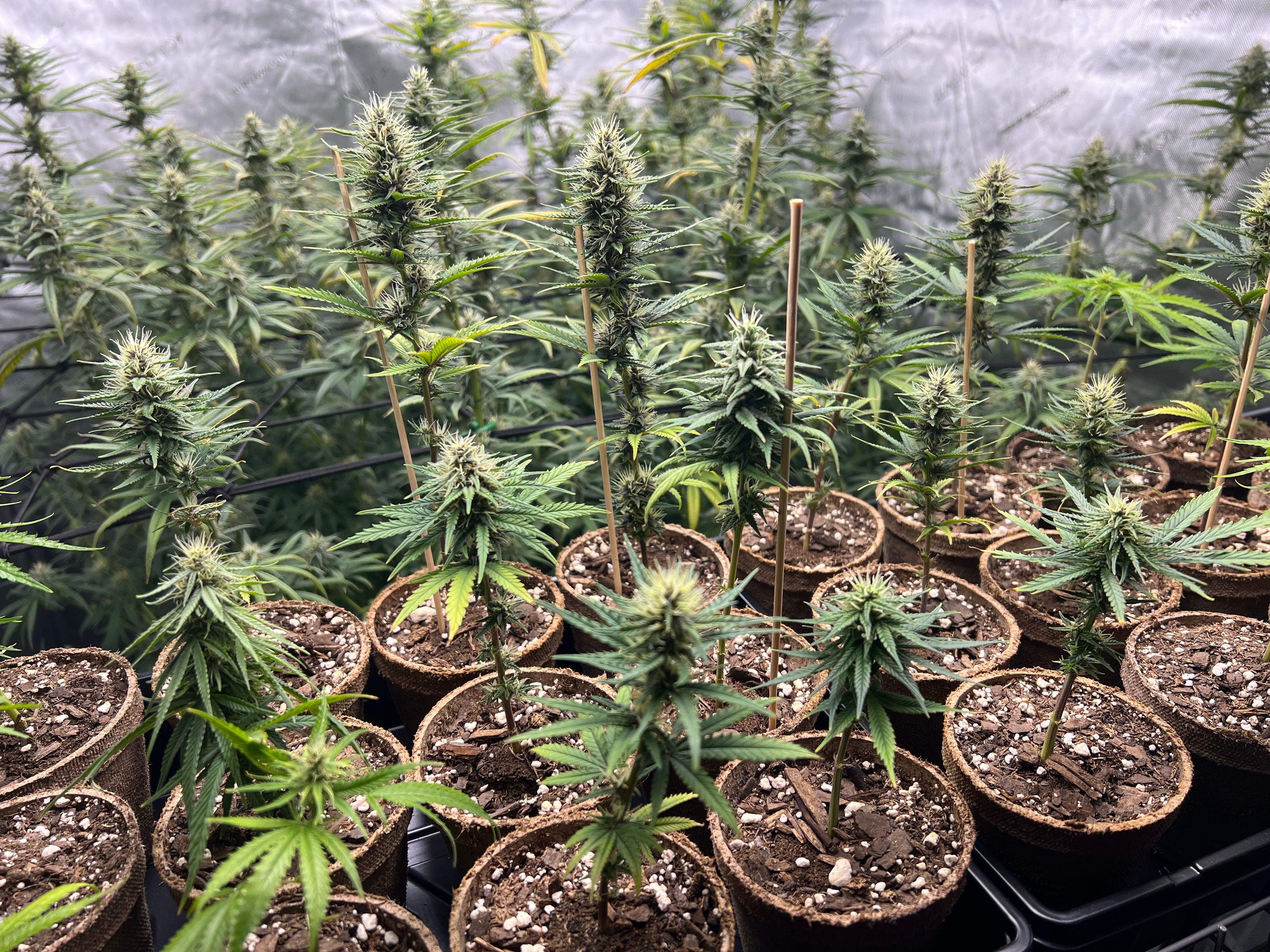


The SCROG method is a plant-training system used to create a wide, flat, and even canopy. The term SCROG means “Screen of Green.” The method uses a horizontal screen or net placed above the plants. As the branches grow, they are carefully guided across the screen instead of being allowed to grow straight upward. This creates a broad layer of plant growth that can make better use of the available space and light.
Cannabis plants naturally tend to grow with one main stem that rises above the smaller side branches. This growth pattern is often called apical dominance. The highest part of the plant may receive more light than the lower branches. Growth near the bottom can become shaded, weak, or less developed. The SCROG method changes this natural shape by spreading the branches across a horizontal area. Instead of having one tall central point, the plant develops several growth points at a similar height.
A level canopy is one of the main goals of SCROG training. Indoor growing lights usually shine downward from above. When the canopy is uneven, the tallest branches may be too close to the light while the shortest branches may be too far away. This can make it difficult to provide balanced light across the whole plant. A flatter canopy places more growing tips at a similar distance from the light source. This may help create more even development across the growing area.
The screen also gives the grower a clear way to organize plant growth. Each branch can be directed toward an open part of the screen. This reduces the chance that several branches will gather in one crowded area. Better spacing can also improve air movement around the leaves. Airflow is important because thick, crowded growth may trap heat and moisture. These conditions can increase the risk of plant stress, pests, or fungal problems.
SCROG is often used when the growing area has limited height. Instead of allowing plants to grow tall, branches are encouraged to grow outward. This makes the method useful in spaces where the distance between the containers and the lighting system is limited. However, SCROG does not remove the need for height planning. The containers, screen, plants, lights, fans, and other equipment all require space. The full growing area should be measured before the screen is installed.
Successful SCROG growing depends on three main parts: setup, training, and plant care. The setup includes the screen, frame, containers, lights, and environmental equipment. The screen must be strong enough to support and guide the branches. It should remain level and should not fall or bend when the plants place pressure on it. The grower must also be able to reach the containers, branches, and equipment after the plants have filled the screen.
Training is the process of shaping and directing the branches. It normally begins while the plants are still young and the stems are flexible. Branches that become thick or woody can be harder to bend without damage. Training must be done slowly and carefully. Forcing a stem into a sharp bend may cause it to split or break. Small changes made over time are usually easier for a healthy plant to manage.
Training may include several techniques. Topping can be used to reduce the dominance of the main stem and encourage more side branches. Low-stress training can help spread these branches before they reach the screen. Once the branches begin growing through the net, they can be guided toward open spaces. These methods should not be applied too aggressively or too often. Plants need time to recover after major cuts, bending, transplanting, or other forms of stress.
Plant care remains important throughout the SCROG process. The screen does not replace proper watering, lighting, nutrition, temperature control, or pest checks. It may even make some care tasks more difficult because the plants cannot be moved easily after their branches are trained into the screen. Watering access, drainage, and plant inspection should be planned before the canopy becomes full.
The area below the screen also needs attention. Weak growth that receives very little light may need to be removed at the proper stage. Dead leaves and plant waste should not be allowed to collect beneath the canopy. Fans should move air above and below the screen without blowing too strongly on one section. The lower branches, stems, growing medium, and containers should remain easy to inspect.
SCROG requires regular attention. It is not a method that can be installed and ignored. Branches may need to be checked and redirected as they grow. The screen can fill quickly during strong vegetative growth and during the early flowering stretch. A grower who waits too long may find that the branches have become stiff, tangled, or crowded. Regular checks can help keep the canopy balanced and reduce the need for severe corrections later.
The method also requires patience. A smaller number of plants may need a longer vegetative period to fill a large screen. Using more plants may fill the area faster, but it may also make the canopy more crowded. Plant count, screen size, container size, and growth time must work together. There is no single setup that is correct for every growing space.
The following sections explain how the SCROG method works, how it compares with other training systems, and how to plan a practical setup. They also cover screen height, plant numbers, branch training, flowering timing, pruning, watering, airflow, and common problems. Autoflowering plants and their special training limits will also be discussed.
Cannabis laws are different in each country, state, and local area. Cultivation should only take place where it is permitted. Local rules may control plant numbers, growing locations, security, and personal use. Anyone considering cannabis cultivation should understand and follow all laws that apply in the area. When used legally and managed with care, the SCROG method can provide an organized way to control plant shape and maintain an even, reachable canopy.
What Is the SCROG Method and How Does It Work?
The SCROG method is a plant training system that uses a flat screen or net to control the shape of a growing plant. SCROG stands for “Screen of Green.” The method encourages branches to grow sideways across the screen instead of growing straight upward. This creates a broad and even layer of plant growth called a canopy.
Cannabis plants naturally try to grow toward the strongest source of light. One main stem often becomes taller than the other branches. This natural growth pattern can create a narrow plant with one high central point and several lower branches. The SCROG method changes this shape. Branches are spread across the available space so that more growing tips can reach the same level.
The screen does more than support the plant. It also acts as a guide. Each branch is directed toward an open part of the screen. Over time, the branches fill the growing area and create a level canopy. This structure may help light reach more flowering sites while making plant height easier to control.
Understanding the Screen of Green Technique
A basic SCROG setup includes one or more plants placed beneath a horizontal screen. The screen may be made from soft netting, string, cord, or another plant-safe material. It contains square openings that allow branches to pass through.
The screen is placed above the containers while the plants are still in their vegetative growth stage. Once branches reach the screen, they are gently bent and guided under it. Each branch is then moved toward a separate opening. New growth is allowed to rise through the screen before being directed again.
This process is often called tucking. Tucking keeps the tallest branches from rising far above the rest of the plant. A grower gently pulls a branch below the screen and guides it toward an empty section. The end of the branch is then allowed to grow upward through another opening.
Training continues as the plant grows. Fast-growing branches are moved farther across the screen, while shorter branches may be allowed to grow upward. The goal is to fill empty spaces without placing too many branches in one area.
A true SCROG system requires active training. A net placed over an untrained plant is not always a SCROG. Sometimes a net is used only to support heavy branches during flowering. That type of net provides support but does not shape the plant during early growth.
SCROG training begins before the canopy becomes crowded. Young stems are softer and easier to bend. Older stems may become thick, stiff, and more likely to split. Gentle and regular training is safer than trying to make major changes after the plant has grown too tall.
How SCROG Creates an Even Canopy
Cannabis plants often show a growth pattern called apical dominance. This means the main stem grows faster and taller than many of the side branches. The highest growing tip receives strong light and produces hormones that support its dominant growth.
Lower branches may receive less light because they are shaded by the upper leaves. They may remain thin or produce small flowering sites. This difference becomes greater when the main stem is allowed to grow far above the rest of the plant.
SCROG training reduces this height difference. The main stem and larger side branches are bent outward instead of being allowed to rise straight up. This lowers the tallest parts of the plant and gives shorter branches time to catch up.
More growing tips may reach the same level when branches are spread across the screen. Light can then be distributed across a wider surface. One tall central stem no longer takes most of the strongest light.
An even canopy also helps a grow light serve the plant more efficiently. Indoor grow lights have a limited area where their light is most useful. Branches that are much lower than the top of the plant may not receive enough light. Branches that grow too close to the fixture may suffer from heat or light stress.
A flat canopy keeps more growth within a similar distance from the light. This makes it easier to adjust the fixture without placing one part of the plant too close or leaving another part too far away. The result is a more balanced growing area.
The screen also separates branches. Each branch can be guided into its own section instead of becoming tangled with nearby growth. Proper spacing may improve airflow and reduce heavy shading. Crowded branches, however, can still trap moisture and block light. The screen must be filled with care rather than packed with as much growth as possible.
The Main Stages of SCROG Growing
The first stage is early plant development. Plants need time to build strong roots, healthy leaves, and several side branches. Weak or stressed plants should not be trained heavily. Healthy plants are more able to respond to bending, topping, and pruning.
The second stage is early shaping. Topping or low-stress training may be used to encourage the plant to grow wider. Topping removes the highest growing point and allows several side branches to become stronger. Low-stress training bends branches outward using soft ties. These methods can prepare the plant before it reaches the screen.
The third stage begins when branches touch the screen. Each branch is directed toward an open square. Longer branches may be guided toward the outer parts of the screen. Shorter branches may remain closer to the center until they grow longer.
The fourth stage is screen filling. Regular checks are needed because branches can grow quickly. New growth is tucked under the screen and moved into open spaces. This continues until enough of the screen has been covered.
The correct amount of coverage depends on how much the plant is expected to stretch after flowering begins. Some plants may grow much taller during the first weeks of flowering. These plants may need to enter flowering before the screen is completely full. Plants with limited stretch may need more time to cover the screen.
The fifth stage is the flowering transition. Plants often grow quickly after the light schedule changes. Training may continue during the early stretch while the branches remain flexible. Once the main stretch slows, flowering tips are usually allowed to grow upward through the screen.
The last stage focuses on support and plant care. The screen helps hold branches in place as flowers gain weight. Watering, pruning, lighting, airflow, and pest checks must continue. Access may become harder once the canopy fills the screen, so the growing space should be planned before training begins.
The SCROG method uses a horizontal screen to guide branches across a growing space. It changes a tall plant into a wide and level canopy. Branches are bent, tucked, and directed toward open sections while they are still flexible.
This method works by reducing the dominance of the tallest stem and helping more branches reach a similar height. A level canopy can improve light distribution, control plant height, support branches, and make better use of indoor space.
Successful SCROG training depends on healthy plants, gentle handling, regular attention, and careful timing. The screen should guide growth without crushing stems or creating a crowded canopy. When the branches are evenly spaced and kept at a similar height, the plant is easier to light, support, and manage throughout flowering.
Benefits, Limitations, and SCROG Comparisons
The Screen of Green method can help growers manage plant shape, light, and space. It uses a horizontal screen or net to guide branches across the growing area. Instead of allowing one main stem to grow much taller than the rest, the branches are spread outward. This creates a wide and more level canopy.
SCROG can be useful in indoor spaces where height and floor area are limited. However, it also needs regular care and careful timing. Before choosing this method, it is important to understand both its benefits and its limits. It is also helpful to compare SCROG with other common training methods, such as Sea of Green and low-stress training.
Main Benefits of the SCROG Method
One of the main benefits of SCROG is better use of available light. Indoor grow lights shine most strongly on the top part of the plant. When one branch grows much taller than the others, it may receive too much light while lower branches remain shaded. A SCROG screen helps keep the branches at a similar height. This allows more growing points to receive useful light.
A level canopy may also make it easier to control the distance between the plants and the light source. When the canopy has many different heights, it can be difficult to place the light correctly. The tallest branch may be too close, while shorter branches may be too far away. A flatter canopy reduces this problem and supports more even growth.
SCROG is also useful for controlling plant height. Some plants stretch quickly during late vegetative growth and early flowering. This can become a problem in rooms, tents, or cabinets with low ceilings. Training branches sideways helps reduce vertical growth. The plant uses more horizontal space instead of growing straight upward.
Another benefit is that SCROG can support branches as they become longer or heavier. The screen holds branches in position and reduces movement. This may help prevent some branches from leaning or falling into nearby growth. A second support net may still be needed later if the branches become very heavy, but the first screen creates a strong base for the canopy.
SCROG may also allow a grower to fill a larger area with fewer plants. Each plant can be trained to cover more space. This may be useful in places where plant numbers are limited by law. However, all local laws and regulations should be checked before cultivation begins.
The method can also improve access to weak growth beneath the canopy. Once the main branches are spread across the screen, small shoots below the net are easier to identify. Growth that receives little light can be removed in a careful and gradual way. This may improve airflow and allow the plant to focus on healthier growth near the top.
Possible Limitations of SCROG
SCROG requires more time during the vegetative stage than some other methods. A plant needs time to grow enough branches to fill the screen. One large plant may take several weeks to cover a wide area. Using more plants can reduce the waiting time, but it also increases crowding and may affect legal plant limits.
Regular attention is another important limit. Branches need to be checked and moved into open areas as they grow. During fast growth, this may need to be done often. If training is delayed, branches may become thick and stiff. Older branches are harder to bend and may break when forced into a new position.
The screen also makes containers difficult to move. Once several branches have grown through or across the net, each plant becomes connected to the setup. A container cannot be lifted, turned, or removed easily. This can make watering, cleaning, and pest control more difficult.
Access may become a serious problem in large or poorly planned grow spaces. Plants at the back of a deep screen can be hard to reach. A grower may struggle to inspect leaves, remove dead material, or check the growing medium. For this reason, the screen should not be wider than the available reach. Walkways and access points should be planned before training begins.
Crowding is another possible problem. Too many branches in one area can block light and reduce airflow. Leaves may overlap, and moisture may remain trapped inside the canopy. This can increase the risk of pests, mold, and plant disease. The screen should be filled evenly, but it should not become packed with too much growth.
SCROG can also make harvest and cleanup more difficult. Branches may be tangled in the screen, especially when they have been woven through many openings. Reusable frames and removable netting can make this process easier. However, the setup still requires more work than growing plants without a fixed screen.
SCROG Versus SOG
SCROG and SOG are often confused because both methods aim to create an even canopy. However, they use very different approaches.
SOG means Sea of Green. This method usually uses many small plants placed close together. The plants spend less time in vegetative growth and are moved into flowering while they are still small. The goal is to produce one main flowering stem from each plant. Training is often limited because the plants are not expected to grow large.
SCROG usually uses fewer plants. Each plant is allowed to grow more branches before flowering begins. These branches are then spread across a screen. The goal is to create many growing points from each plant instead of relying mainly on one central stem.
SOG may produce a full canopy faster because many plants are used. However, it requires more containers, more root zones, and a higher plant count. This may not be suitable in areas with strict legal limits. It can also require more work during watering because each container must be managed.
SCROG takes longer to prepare, but it can make better use of a small number of plants. It gives the grower more control over branch position and canopy shape. The best method depends on the available space, legal rules, plant type, and time available for training.
SCROG Versus Low-Stress Training
Low-stress training, often called LST, involves gently bending and tying branches to control plant shape. The goal is to spread the plant outward without making major cuts or causing heavy stress.
LST can be used without a screen. Branches may be tied to the edge of a container, to stakes, or to other supports. This makes the plant easier to move because it is not attached to a fixed net. LST can be a good choice for smaller spaces or for growers who need to move containers often.
SCROG often includes low-stress training as part of the process. A plant may be bent and tied before it reaches the screen. Once the branches touch the net, they are guided into open sections. The screen then replaces some of the ties and helps keep the canopy level.
The main difference is that SCROG uses a fixed structure to organize several branches across a larger area. LST is more flexible and may be used on one plant without building a frame. SCROG offers more support and control, but it also reduces movement and access.
SCROG can improve light use, control plant height, support branches, and help a small number of plants cover a wider area. It is useful for creating a level canopy in indoor spaces. However, it needs regular training, careful planning, and good access to every plant.
Compared with SOG, SCROG uses fewer plants and requires more vegetative growth. Compared with LST, it uses a fixed screen that offers more structure but less flexibility. No single method is best for every growing space. The right choice depends on plant numbers, room size, available height, access, and the amount of time that can be given to plant training.
Planning the Growing Space, Plant Count, and Containers
A successful screen-based growing system begins long before branches reach the net. The growing area, number of plants, container size, and access points must all be planned early. Once branches are trained through a screen, moving the plants becomes difficult. Poor planning can make watering, pruning, cleaning, and plant inspection harder than necessary.
The main goal is to create a space where plants can spread across the screen without becoming crowded. Each plant needs enough root space, light, airflow, and room for branch growth. The grower must also be able to reach the containers and equipment throughout the full growing cycle.
Measuring the Available Growing Space
Start by measuring the length, width, and height of the growing area. These measurements show how large the screen can be and how much vertical room is available. Usable height is often less than the full height of the room or grow tent.
Containers take up space at the bottom of the growing area. The screen sits above the containers, while the plant canopy develops above the screen. Lights, fans, filters, and hanging equipment also use vertical space. Safe space must remain between the top of the plants and the lighting system.
The screen should fit within the growing area without touching the walls on every side. A small gap around the edges can improve air movement and make cleaning easier. It may also provide space for reaching branches along the outside of the canopy.
Access is another major concern. A screen that fills the full width of a room may look efficient, but plants at the back can become hard to reach. This can make it difficult to check leaves, remove weak growth, or inspect the growing medium.
A narrow setup may be reached from one side. A wider setup often needs access from two or more sides. Walkways should be wide enough for safe movement. Electrical cords, irrigation lines, and drainage trays should not block these paths.
The final layout should include room for lighting, airflow equipment, watering tools, and runoff collection. Planning these details before installing the screen can prevent major problems later.
Choosing the Number of Plants
The correct number of plants depends on the size of the screen, the natural shape of the plants, the container size, and the amount of time allowed for growth. There is no single plant count that works for every space.
One plant can sometimes fill a wide area if it has enough time to grow and develop several strong branches. This approach may require a longer growth period. The plant must be trained outward in several directions so that it slowly covers the screen.
Several smaller plants may fill the same area more quickly. Each plant has less distance to spread before its branches meet those of nearby plants. However, using more plants can create a crowded root zone and make watering more complex.
The number of plants also affects access. Closely spaced containers may leave little room for removing runoff or checking the lower stems. Dense growth can reduce airflow below the screen, especially near the center of the canopy.
Plants that share one screen should have similar growth rates whenever possible. A fast-growing plant may rise above slower plants and block their light. Plants with very different heights may require constant adjustment to maintain a level canopy.
The goal is not to place as many plants as possible under the screen. The goal is to create an even canopy that can be reached and maintained. Fewer healthy plants with enough space are often easier to manage than many crowded plants.
Local rules should also be considered when deciding how many plants to grow. Only plants that are legal to cultivate in the local area should be used.
Selecting Suitable Plant Characteristics
Plants with flexible branches are usually easier to guide through a screen. Young stems can be bent and redirected with less risk of snapping. Thick or woody stems may resist training and can break when forced into a new position.
Strong side branching is also helpful. A plant with several healthy branches can spread across a wider part of the screen. Plants that grow mainly from one central stem may need early shaping before they can cover a large area.
Growth speed should be predictable. Plants that stretch quickly may fill open spaces faster than expected. Compact plants may need more time before they cover the screen. Understanding the normal growth pattern can help determine when to begin training.
When several varieties are grown together, their height and growth habits should be similar. Mixing a short, compact plant with a tall, fast-growing plant can create an uneven canopy. The taller plant may need constant bending, while the shorter plant may struggle to reach the screen.
Only healthy plants should be placed into a fixed screen system. Weak plants may not recover well from bending or pruning. Signs of pests, root problems, poor drainage, or damaged leaves should be corrected before intensive training begins.
Selecting Containers and Growing Medium
Container size should match the expected size of the plant and the length of the growing period. A plant that remains in growth for a long time may need more root space than a plant trained for a short period.
Roots need water, oxygen, nutrients, and drainage. A container that is too small may dry out quickly and restrict root development. A container that is too large may hold moisture for too long if the growing medium drains poorly.
Rigid plastic containers are strong and easy to clean. They also hold their shape when moved. Fabric containers allow more air to reach the outer root zone, but they may dry faster. Both types can work when they are matched with a suitable growing medium and watering method.
Every container should have drainage holes. Water must be able to leave the root zone instead of collecting at the bottom. Runoff trays should be placed under the containers before the screen is filled.
The growing medium should drain well while holding enough moisture for the roots. Heavy, compact material may remain wet for too long and reduce oxygen around the roots. Very loose material may dry too quickly and require frequent watering.
Containers should be placed in their final positions before branches are trained into the screen. After the canopy spreads, lifting or turning a container can damage stems. Final placement should allow access to the growing medium, drainage trays, and lower plant growth.
Planning is one of the most important parts of a screen-based growing system. The growing area must provide enough room for the screen, containers, lights, fans, and safe access. Plant numbers should be based on available space and growth habits rather than a desire to fill the area with as many plants as possible.
Suitable plants should be healthy, flexible, and able to form strong side branches. Containers must offer enough root space and proper drainage. They should also be placed in their final positions before training begins. Careful planning creates a canopy that is easier to water, inspect, shape, and maintain throughout the growing cycle.
Building and Installing the SCROG Setup
A strong SCROG setup gives cannabis plants a safe frame for training and support. The screen must stay level, tight, and stable as the plants grow. It should also allow enough room for watering, pruning, checking leaves, and cleaning the growing area.
Planning the setup before the plants reach the screen can prevent many problems later. Once branches grow through the net, moving the containers or changing the frame becomes much harder. For this reason, growers should test the full setup before training begins.
Equipment Needed for a Basic SCROG
A basic SCROG system starts with a strong frame. The frame holds the screen above the plants and keeps it from sagging. It may be made from wood, plastic pipe, metal tubing, or another stable material. The frame should fit the growing space without blocking doors, fans, lights, or walking paths.
The screen may be made from trellis netting, cord, string, or rigid mesh. Each material has different benefits. The main purpose is to create even openings where branches can be guided and supported.
Fasteners are also needed to connect the screen to the frame. Cable ties, hooks, clips, screws, or knots may be used. The fasteners should hold the net firmly without making it difficult to adjust or remove.
Soft plant ties and training clips can help control branches before and after they reach the screen. Soft materials are safer because they are less likely to cut into the stems. Thin wire should not press directly against plant tissue.
Clean pruning tools are useful for removing damaged leaves, weak shoots, or crowded growth. The tools should be sharp enough to make clean cuts. Dull blades can crush stems and slow recovery.
The setup must also include containers, runoff trays, lights, fans, and climate control equipment. Every item should be placed before the screen becomes full. Watering tools, drainage tubes, or collection trays may also be needed because reaching the containers can become difficult later.
Choosing a Screen Material
Soft trellis netting is light, simple to install, and easy to store. It can bend around branches and may be cut away during harvest. However, some soft nets can stretch or sag when branches become heavy. A loose screen may not hold plants in the correct position.
String or cord can be tied across a frame to create a custom grid. This option allows the grower to choose the exact size of each opening. The cord should be strong enough to stay tight but soft enough to avoid scraping the stems.
Rigid mesh provides stronger support and keeps its shape well. It may be useful for large or heavy plants. Still, rigid materials can be harder to remove. Sharp edges may also damage branches or hands. Any rough or pointed areas should be covered or removed before use.
Reusable frames are helpful for growers who plan to use the SCROG method more than once. A reusable screen should be easy to clean between growing cycles. Old leaves, dust, moisture, and plant material should not remain on the frame.
The best screen material is one that stays tight, supports the plants, and allows safe access. It should not bend under light pressure or move every time a branch is tucked. A screen that shifts can pull on trained branches and cause damage.
Choosing the Mesh Opening Size
The openings in the screen must be large enough for branches, leaves, and hands to pass through. When the openings are too small, training becomes slow and difficult. Branches may become trapped, and removing them later can cause breaks.
Small openings may also create too many contact points around the stems. As branches grow thicker, tight netting can press into the plant tissue. This may restrict movement or damage the outer layer of the stem.
Very large openings can also cause problems. They provide less control over branch placement and may leave wide gaps in the canopy. Branches can lean or fall into the same open space, which may create uneven growth.
A medium-sized grid is often easier to manage because it gives each branch its own space. The exact opening size depends on the strength of the branches, the size of the growing area, and the type of training being used.
The grid should make it easy to move a branch into the next open section without forcing it. Growers should also be able to reach through the screen to remove leaves or inspect the lower canopy.
How High Should a SCROG Net Be?
There is no single screen height that works for every growing space. The correct height depends on the container size, plant structure, available room, and expected stretch during flowering.
The screen should be high enough to allow access under the canopy. Growers may need to water the soil, empty runoff trays, inspect stems, or remove weak growth. A screen placed too low can make these tasks uncomfortable or impossible.
A screen placed too high may also create problems. Plants may need a long vegetative period before the branches reach the net. The stems may become thick and stiff before training starts, which makes bending more difficult.
The screen should meet the branches while they are still young and flexible. At this stage, they can be guided across the grid with less risk of snapping. The containers should already be in their final positions before this happens.
Available height above the screen must also be considered. Space is needed for upward flower growth, lights, fans, and safe distance from the light source. Plants that stretch a great deal during flowering may require a lower screen or an earlier switch to the flowering stage.
An adjustable frame can make the setup easier to manage. It allows the screen height to be changed before the branches become fixed in place. Once the net is full, major height changes should be avoided because they may pull or bend several branches at once.
Testing the Setup Before Training
The complete SCROG setup should be tested before any branch is placed into the screen. The frame should not shake, tilt, or move when light pressure is applied. Every corner should be secure.
The screen should be tight and level. A sagging center can cause branches to gather in one area. Uneven screen height can also create an uneven canopy.
Lights should be tested to make sure they can still be raised or lowered. Fans should move air above and below the future canopy. No part of the frame should block important airflow.
Growers should also test access to every container. Water should be easy to apply without spilling on electrical equipment. Runoff trays should be removable or connected to a safe drainage system.
Cables, plugs, and power strips must remain away from standing water. The growing area should allow safe movement without the need to step over wires, containers, or tools.
Every section of the future canopy should be reachable. If the back of the screen cannot be accessed, long-handled tools or a different room layout may be needed. It is better to correct access problems before branches fill the net.
A successful SCROG setup begins with a stable frame, a tight screen, and enough space for plant care. The screen material should be strong, smooth, and easy to manage. Mesh openings should allow branches and hands to pass through without creating large gaps.
Screen height should match the plants, containers, growing space, and expected flowering stretch. Most of all, the full setup should be tested before training begins. Careful planning makes watering, pruning, lighting, and branch control much easier throughout the growing cycle.
When to Start SCROG Training and Prepare the Plants
The timing of SCROG training can have a major effect on plant health and canopy shape. Training should not begin simply because a plant has reached a certain age. Plants grow at different speeds based on genetics, light, root space, temperature, and general care. A better approach is to examine the condition and structure of each plant before starting.
SCROG training works best during the vegetative stage, while stems are still young and flexible. At this stage, plants can usually adjust to gentle bending and shaping more easily. Training plants that are weak, dry, damaged, or under stress may slow their growth. For this reason, preparation should always come before active training.
Starting With Healthy Plants
Only healthy plants should be placed under the stress of regular SCROG training. A healthy plant normally has steady new growth, firm stems, and leaves with an even color. The growing tips should continue to develop without major signs of damage.
Plants that have recently been transplanted should be given enough time to settle into their new containers. Transplanting can disturb the root system, even when it is done carefully. Starting branch training too soon may place several forms of stress on the plant at the same time. Waiting until new growth appears is a simple way to confirm that the roots have started working well again.
Watering problems should also be corrected before training begins. A plant that has been overwatered may have weak growth, drooping leaves, and low oxygen around the roots. A plant that is too dry may have soft stems or wilted leaves. Neither condition is suitable for bending or pruning.
Plants should also be checked for pests and disease. The lower leaf surfaces, stems, growing tips, and growing medium should be inspected. A dense SCROG canopy can make pest control more difficult later because some areas become hard to reach. Finding and correcting a problem before the screen fills is much easier than treating it after branches become tangled.
When to Begin Training
Training should usually begin during vegetative growth, when the plant has formed several healthy branches. The stems should be long enough to guide outward, but they should not be so old that they have become hard and woody.
Plant size is more useful than plant age when choosing the starting point. Two plants that were started on the same day may not be ready at the same time. One may grow quickly and form strong side branches, while the other may remain small. Each plant should be judged based on its own condition.
Young branches are easier to move because their tissues are softer. Thick, mature stems are more likely to split when pushed into a new position. Early shaping allows small changes to be made over time. This is safer than waiting until the plant is tall and trying to correct its whole structure at once.
Plants grown from clones may begin with a different shape than plants grown from seed. A clone may already have several side branches, while a seed-grown plant may first develop one clear central stem. These differences can affect when and how the plant reaches the screen.
Topping and Branch Development
Topping is a training method that removes the main growing tip. The purpose is to reduce the control of one central stem and encourage more side branches to develop. These branches can later be spread across different sections of the SCROG screen.
Topping should only be considered when the plant is growing strongly. Removing the main tip from a weak or recently stressed plant may slow development. Clean pruning tools are also important because damaged or dirty tools may increase the risk of infection.
After topping, the plant needs time to recover. New branches should begin growing from the points below the cut. The plant should not be topped again immediately. Several stressful actions completed within a short period can reduce growth and weaken the plant.
Topping is not required for every SCROG plant. Some plants naturally produce several strong side branches. These plants may be shaped through gentle bending without removing the main growing tip. The decision should be based on plant structure, health, and the amount of time available for vegetative growth.
Using Low-Stress Training Before the Screen
Low-stress training helps guide branches outward before they reach the screen. The aim is to create a wide plant with several growing tips instead of one narrow plant with a tall central stem.
Branches should be moved gradually. A stem that resists movement should not be forced into a sharp bend. Small adjustments made over several days are often safer. Soft plant ties may be used to hold branches in position. Thin wire, rough string, or tight knots can cut into stems as they grow thicker.
Ties should be checked often. A loose tie may stop supporting the branch, while a tight tie may damage the outer tissue. Enough space should remain for the stem to expand.
Main branches can be directed toward different parts of the future canopy. This early spacing prevents several branches from reaching the same section of the screen. It also makes later tucking easier because each branch already has a general direction.
Low-stress training should not leave branches pressed against wet soil or the edge of a container. Each branch needs enough support, light, and airflow. The center of the plant should also remain open enough for air to move between leaves.
Deciding When the Plant Is Ready for the Net
A plant may be ready for the SCROG net when it has several active side branches that can be guided toward separate openings. The branches should be flexible, healthy, and long enough to reach the screen without being pulled too hard.
The plant should also have recovered from any recent topping, pruning, or transplanting. Active new growth is one of the clearest signs of recovery. Leaves should not remain heavily drooped, damaged, or discolored.
Containers should be placed in their final positions before branches are trained through the screen. Moving a plant becomes difficult once several branches are connected to the net. Runoff trays, watering access, fans, and other equipment should also be arranged before the canopy becomes fixed in place.
The screen does not need to be filled as soon as the plants reach it. Early branches can be guided slowly into open areas as new growth develops. Careful timing keeps training gentle and gives the plant time to adjust.
Successful SCROG training begins with healthy and active plants. Training should start during vegetative growth while branches are young and flexible. Plant condition is more important than following a fixed number of days or weeks.
Topping may help create several main branches, but it should only be used on strong plants that have enough time to recover. Low-stress training can then spread branches outward and prepare them for the screen. Before the net is filled, containers, watering access, and growing equipment should be placed in their final positions.
Careful preparation reduces stress and makes the SCROG canopy easier to manage. Healthy roots, flexible stems, balanced branches, and steady new growth are the main signs that a plant is ready to begin screen training.
Filling the Screen Through Tucking and Canopy Training
Filling the SCROG screen is one of the most important parts of the Screen of Green method. The goal is to guide branches across the screen until the growing space has a wide and even canopy. Each branch should have enough room to grow without being crowded by nearby stems or leaves.
This process takes time and regular attention. Plants continue to produce new growth each day, so the position of the branches must be checked often. Careful training helps prevent tall branches from taking over the canopy. It also allows shorter branches to reach areas where they can receive more light.
The screen should guide plant growth rather than trap or damage the branches. Gentle movements, proper timing, and steady care are more effective than forceful bending.
Understanding Tucking and Weaving
Tucking means guiding a branch under the screen and moving its growing tip toward an open section. The branch is not always pushed through several openings. Instead, it is placed below the net so that it can continue growing in a horizontal direction.
Weaving involves moving a branch over and under several parts of the screen. This method may hold the branch in place, but it can also make later adjustments difficult. Tight weaving may trap the branch as it becomes thicker. It may also cause damage when the plant moves or when the branch must be removed from the screen.
Gentle tucking is often easier to manage. A branch can be guided under the net and moved into a nearby empty square. The growing tip can then turn upward toward the light. This process may be repeated as the branch grows longer.
Branches should not be twisted, pulled, or pushed through small openings. Stems become thicker over time, and a tight screen can press into the plant tissue. Enough space should remain around each branch to allow normal growth.
Frequent checks are important during this stage. Young branches may grow several centimeters in a short period. A branch that was level with the canopy may rise above the others after a few days. Regular tucking helps keep the top of the canopy even.
Directing Branches Across the Screen
Each branch should be directed toward an open part of the screen. Taller and faster-growing branches can be moved toward areas farther from the main stem. Shorter branches can remain closer to the center until they gain more length.
The middle of the screen often fills faster than the edges. This happens because many branches begin near the center of the plant. Moving strong branches outward helps prevent the middle from becoming too dense. It also helps use the full growing space.
Several branches should not be placed in the same opening. Crowded branches may block light, reduce airflow, and rub against each other. One main branch or growing tip in each area usually creates a cleaner structure.
Branch positions may need to change as the plant grows. A branch that was directed toward one side may later need to be moved toward another open section. Adjustments should be small and careful. Sudden changes can bend the stem too sharply.
The main goal is a level canopy. No single branch should rise far above the others. A tall branch may receive more light and continue growing faster. This can create an uneven canopy and reduce the amount of light available to lower growth.
Shorter branches should not be forced to reach distant openings. They can be allowed to grow upward until they become long enough to move. Training should follow the natural growth of the plant rather than placing every branch under heavy pressure.
How Full Should the Screen Be?
The correct amount of screen coverage depends on how much the plants are expected to stretch after the flowering stage begins. Some plants grow much taller during the first few weeks of flowering. Others remain more compact.
Plants that stretch heavily may need to enter flowering before the screen is completely full. Their branches can continue filling empty spaces during the early flowering period. Waiting too long may cause the screen to become overcrowded.
Compact plants may need more time in the vegetative stage. More of the screen may need to be covered before flowering begins because the branches may not stretch very far later.
Every opening does not need to contain a branch before flowering. Future growth must be considered. A screen that appears slightly open at the end of vegetative growth may become full during the flowering stretch.
An overfilled screen can create several problems. Branches may overlap, leaves may block airflow, and growing tips may compete for space. Watering and pruning may also become harder. Dense growth can trap moisture inside the canopy, which may raise the risk of plant health problems.
An underfilled screen may leave large empty areas. This can reduce the useful canopy size and leave some light falling on unused space. Careful observation helps find the right balance.
Preventing Damage During Training
Young stems are easier to bend than older stems. Training should take place while the branches are still green and flexible. Thick or woody branches are more likely to split when forced into a new position.
One hand should support the stem near the bending point while the other hand moves the growing tip. This gives better control and reduces pressure on the branch. Small adjustments are safer than one large bend.
A branch should not be bent until it makes a sharp crease. Signs of damage include cracking sounds, split tissue, crushed stems, or sudden drooping. Training should stop when the branch begins to resist strongly.
Soft plant ties may be used to hold loose branches in place. Ties should not be pulled tight around the stem. Enough room must remain for the branch to become thicker. Ties should also be checked often and adjusted when needed.
A partially bent branch may still recover if the damaged area is supported. Plant tape or a soft tie can hold the split parts together. The branch should be handled as little as possible while it heals. Severe damage may slow growth or cause the branch to die, so prevention is always the safer approach.
Keeping Training Records
Simple records can make SCROG training more accurate. Notes can include the date of topping, the date the screen was installed, and the time needed to fill each part of the canopy.
The speed of plant growth should also be recorded. Some cultivars may fill the screen quickly, while others need a longer vegetative period. Stretch during early flowering is another useful detail.
Photographs taken from the same position can show how the canopy changes over time. These images can make it easier to notice empty areas, crowded sections, or uneven growth.
Records are especially useful for future growing cycles. They may help determine when to begin training, how much screen coverage is needed before flowering, and how far branches should be spaced.
Filling a SCROG screen requires patience, gentle handling, and regular checks. Branches should be tucked toward open areas instead of being tightly woven through the net. Taller growth can be guided toward the edges, while shorter branches can fill spaces closer to the center.
The screen should not become so full that branches overlap and airflow becomes poor. Future flowering stretch must be considered before every opening is filled. Small and careful adjustments help prevent broken stems and other plant damage.
Good records can also improve future results. Training dates, growth speed, screen coverage, and flowering stretch provide useful information for planning the next cycle. A well-filled screen should create an even, open, and manageable canopy that supports healthy growth.
Switching to Flowering and Managing the Stretch
The move from vegetative growth to flowering is one of the most important stages in the SCROG method. Plants often grow much faster during this change. This period of rapid growth is known as the flowering stretch. Branches may become longer, the distance between growth points may increase, and the canopy may rise above the screen.
Good timing is important. Switching too early can leave large empty areas in the screen. Switching too late can create a crowded canopy that is hard to manage. The main goal is to begin flowering when the screen has enough healthy branches to fill the remaining space during the stretch.
Plant growth can vary based on genetics, health, growing conditions, and available space. For this reason, the decision should be based on the condition of the canopy rather than a fixed number of days.
When to Switch a SCROG to Flowering
The best time to begin flowering depends on how much of the screen is already covered. It also depends on how much the plants are expected to stretch. Some plants produce long branches during early flowering. Others stay more compact and add only a small amount of height.
Plants that stretch heavily may need to enter flowering before the entire screen is full. Their branches can continue growing across the remaining open sections during the first part of flowering. Compact plants may need more time in vegetative growth because they may not spread far after flowering begins.
Switching too early can lead to poor use of the growing area. Empty sections may remain between branches, which can create uneven light use. Some areas may contain strong growth, while other parts of the screen may remain open. This can reduce the main benefit of the SCROG method, which is the creation of a wide and balanced canopy.
Waiting too long can also cause problems. A screen that is already full before flowering may become overcrowded during the stretch. Several branches may compete for the same space. Leaves can overlap, airflow may become weaker, and some flowering sites may become shaded. Tall branches may also grow too close to the light.
Plant health should be checked before flowering begins. The leaves should appear healthy, and the plants should be growing at a steady rate. Serious pest, watering, or nutrient problems should be managed before changing the growth stage. A weak plant may have trouble handling both environmental changes and continued training at the same time.
Major pruning, transplanting, and heavy branch training should not all take place during the same short period. Giving the plant time to recover between stressful actions can help maintain steady growth.
Managing Early Flowering Stretch
During the early flowering stretch, branches may grow quickly through and above the screen. Regular checks are important because a branch that appears level one day may rise above the canopy soon after.
Taller branches can be guided toward open sections of the screen while they are still flexible. The growing tip can be moved gently under the net and directed toward a nearby opening. This keeps the branch lower and allows it to continue growing across the canopy.
Shorter branches should usually be given space to rise. Placing a short branch under too many sections of the screen may prevent it from reaching useful light. The aim is not to treat every branch in the same way. Taller growth needs more control, while shorter growth may need time and space to catch up.
Each opening should have enough room for leaves and developing flowering sites. Several branches should not be forced through the same small section. Crowded growth can trap moisture and reduce air movement. It can also make inspection and pruning more difficult.
The screen should be checked for pressure points. Stems can become thicker as the plant grows. A branch that rests tightly against the net may become scraped or pinched. Soft netting and gentle positioning can reduce this risk. Branches should never be pulled with enough force to split or crush the stem.
Lighting may need to be adjusted as the canopy rises. The space between the plant tops and the light should remain suitable for the type of equipment being used. Leaves near the top should be checked for signs of stress, such as curling, pale areas, or dry edges. A level canopy makes it easier to provide balanced light across the growing space.
When to Stop Tucking Branches
Tucking should not continue throughout the entire flowering stage. Branches become firmer as flowering develops. Young stems are usually easier to bend, while older stems may become stiff and more likely to crack.
The main period for tucking is often during late vegetative growth and the early flowering stretch. Once rapid stretching begins to slow, the main branches can be allowed to grow upward through the screen. These upright sections will hold the developing flowering sites.
The correct stopping point can vary from plant to plant. Growth should be observed closely. When branches stop gaining length quickly and begin focusing more energy on flower development, frequent tucking becomes less useful.
Late bending can damage developing flowers and supporting stems. It can also disturb the spacing that was created earlier. Once the canopy has reached its final shape, training should become lighter. Care should focus more on support, airflow, inspection, and general plant health.
A second net may be added above the first screen when extra support is needed. This upper layer is not always used for training. Its main purpose may be to hold branches upright as they become heavier. The lower screen shapes the canopy, while the upper screen can help support later growth.
Supporting Developing Flowers
As flowers become larger, branches may lean or bend under their weight. The original SCROG screen should remain tight enough to support the canopy. A loose or sagging net may allow branches to fall together, which can create crowded sections.
Branches that lean into nearby growth should be separated carefully. Each flowering site needs enough space for light and moving air. Branches can be supported with soft ties, plant clips, or an additional net when necessary. Support materials should not cut into the stems.
Airflow remains important throughout flowering. Air should move gently above and below the screen. Dense areas should be checked for overlapping leaves, dead plant material, and trapped moisture. Fans should not blow strongly on one part of the canopy for long periods because this may dry or damage nearby leaves.
The plants should also be inspected without excessive handling. Flowers and branches become more sensitive during later growth. Support work should be done slowly to avoid breaking stems or disturbing developing plant tissue.
Switching a SCROG canopy to flowering requires careful timing and regular observation. The screen should contain enough growth to use the available space, but it should not be so full that the flowering stretch creates heavy crowding. Expected plant stretch, canopy health, and available height should all guide the decision.
During early flowering, tall branches can still be directed toward open spaces while they remain flexible. Shorter growth should be allowed to rise, and crowded sections should be opened when possible. Tucking should slow and then stop as stems become firm and flowering sites develop.
Later care should focus on branch support, balanced light, good airflow, and a stable canopy. A well-managed flowering transition helps the SCROG remain level, reachable, and healthy as the plants move toward the final stage of growth.
Watering, Lighting, Nutrition, and Environmental Care
A SCROG canopy depends on more than branch training. Plants also need steady watering, balanced light, suitable nutrition, and a stable growing environment. These needs become harder to manage after branches spread across the screen. Containers may be difficult to reach, leaves may block airflow, and parts of the canopy may receive different amounts of light.
Careful planning helps prevent these problems. Watering tools, fans, lights, drainage trays, and other equipment should be placed before the screen becomes full. Each part of the growing area should remain easy to inspect. Regular checks are important because small problems can spread through a dense canopy.
Cannabis cultivation should only take place where it is permitted by local law. Electrical equipment, water, and high humidity must also be managed safely.
Watering Plants Beneath a Fixed Screen
Watering can become difficult after branches are trained through the net. The plants may no longer be easy to move. Containers at the back of the growing area may also become hard to reach. A watering plan should be created before the canopy becomes dense.
A long-neck watering can, flexible tube, or controlled irrigation line may help reach containers beneath the screen. Water should be applied slowly so it can spread through the growing medium. Pouring too quickly may cause water to run down the sides of the container without reaching the center of the root zone.
Each container should receive enough water to moisten the growing medium evenly. However, plants should not be watered only because a fixed number of days has passed. Water use can change based on plant size, temperature, humidity, airflow, container type, and growth stage.
The surface of the medium may look dry while deeper sections are still wet. Container weight can provide useful information. A recently watered container feels heavier than one that is ready for water. Moisture meters may also help, but they should not replace regular observation.
Overwatering may reduce the amount of oxygen around the roots. Common signs include drooping leaves, slow growth, and a growing medium that stays wet for a long time. Underwatering may cause leaves to hang down, the medium to pull away from the container edges, and the container to feel very light.
Drainage also needs attention. Water should be able to leave the container without collecting around the roots. Runoff trays must be easy to reach and empty. Standing water can increase humidity and may attract pests. It can also create a risk when electrical cords or equipment are nearby.
Hidden containers should be checked for blocked drainage holes, leaking trays, or uneven watering. A fixed screen can hide these problems, so regular inspection is important.
Maintaining Even Light Across the Canopy
One main goal of SCROG training is to create a level canopy. A flat canopy allows more growing points to remain at a similar distance from the light. This can reduce the difference between bright areas and shaded areas.
The center of the canopy often receives more light than the edges. Plants near the sides should be checked for stretching, weak growth, or leaves turning toward the center. Light placement may need to be adjusted so the useful growing area covers the full screen.
Light distance should be changed as the canopy rises. A light that is too far away may cause branches to stretch. A light that is too close may cause leaf edges to curl, upper leaves to become pale, or plant tissue to dry out. Heat may also build up near the top of the canopy.
More light does not always lead to healthier growth. Plants can only use strong light when water, nutrition, temperature, and carbon dioxide levels are suitable. Too much light may stress the plant even when the room does not feel hot.
A level canopy should be maintained during early flowering stretch. Branches that rise above the others may need gentle redirection while they are still flexible. Later in flowering, stiff branches should not be forced into severe bends. Raising or adjusting the light may be safer than damaging a developed branch.
The light fixture should also be checked for secure mounting. Watering tools and irrigation lines should never touch hot fixtures, power strips, or exposed electrical connections.
Managing Plant Nutrition
SCROG plants need balanced nutrition, but the training method does not automatically mean they require stronger feeding. Nutrient needs depend on the growing medium, plant size, growth stage, water quality, and the product being used.
Product instructions should be followed carefully. Starting with a mild feeding level may reduce the risk of nutrient burn. Strong fertilizer mixtures can damage roots and cause leaf tips to turn brown. Adding more nutrients without checking the cause of a problem may make the condition worse.
Leaf color and growth rate can provide useful clues. Pale leaves may be linked to several causes, including low nutrition, poor root health, incorrect pH, overwatering, or weak light. Dark green leaves and burned tips may suggest excessive feeding, but these signs should be considered together with watering and environmental conditions.
Changes should be made gradually. Several adjustments at the same time make it difficult to identify the true cause of a problem. For example, changing the nutrient strength, watering schedule, light height, and temperature on the same day may create more stress.
Heavy pruning can also change water and nutrient use. A plant with fewer leaves may use less water for a short time. Feeding and watering should be based on current plant response rather than the previous schedule.
The pH of the water or nutrient solution may affect how well roots absorb nutrients. The suitable range depends on the growing medium. Soil, coco-based media, and water-based systems do not always use the same target range. Accurate testing equipment should be kept clean and checked regularly.
Controlling Temperature and Humidity
Temperature and humidity affect how plants take up water and release moisture through their leaves. A stable environment supports steady growth. Large changes between day and night may place stress on the plants.
A dense SCROG canopy can trap warm, moist air. The upper leaves may appear dry while humidity remains high below the screen. This hidden moisture can increase the risk of fungal growth, especially when flowers become thick.
A thermometer and humidity meter should be placed near canopy height. One reading from the floor or wall may not show the conditions around the leaves. Extra sensors can help identify warm or humid areas in a large setup.
Humidity often needs to be lower during flowering than during early vegetative growth. Dense flowers hold moisture and may dry slowly. Exhaust fans, intake vents, and dehumidifiers may help control the environment when needed.
Sudden changes should be avoided when possible. A sharp drop in humidity or a large rise in temperature may cause rapid water loss. Gradual adjustments are easier for plants to handle.
Providing Airflow Above and Below the Screen
Air movement helps reduce hot spots and humid pockets. Fans should move air across the top of the canopy and through the space below the screen. Leaves should move gently rather than shake or fold under strong wind.
A fan aimed at one area for many hours may dry leaves and stems. This can create damage that looks similar to heat or watering stress. Oscillating fans often spread air more evenly.
The lower canopy needs special attention. Crowded leaves, containers, trays, and branches may block air movement. Small fans may be placed below the screen, but they must remain dry, stable, and clear of loose plant material.
Dead leaves should not be allowed to collect on the floor or inside trays. Decaying plant material can hold moisture and provide shelter for pests. Clean surfaces also make it easier to notice insects, leaks, and fallen flowers.
Exhaust and intake paths must remain open. Filters should be checked for dust, and fans should be inspected for reduced airflow. A room can become warmer and more humid when ventilation equipment becomes blocked.
Inspecting for Pests and Disease
A SCROG screen can make pest inspection difficult. Leaves overlap, branches cross, and the lower parts of plants may be hidden. Plants should be checked often before the canopy becomes too thick.
Leaf undersides are common places for insects and eggs. Stems, branch joints, container edges, and the screen itself should also be inspected. A small light or mirror can help examine areas that are difficult to see.
Possible warning signs include small spots on leaves, webbing, sticky surfaces, unusual curling, damaged stems, and insects flying near the growing medium. Fungal problems may appear as pale powder, soft plant tissue, brown flower sections, or areas that smell unusual.
Affected material should be handled carefully. Tools should be cleaned between plants to reduce the risk of spreading pests or disease. Dead or infected material should be removed from the growing area.
Sprays should not be used without checking whether they are suitable for the plant stage and legal for the intended crop. Products applied during flowering may remain on plant material. Good sanitation, airflow, and early detection are often safer than waiting for a serious problem to develop.
Watering, lighting, nutrition, and environmental control are closely connected in a SCROG setup. A problem in one area can quickly affect the rest of the canopy. Too much water may weaken roots, poor airflow may raise humidity, and uneven light may create weak or stressed growth.
The best care routine is based on regular observation. Containers should drain well, runoff should be removed, and the canopy should receive even light. Nutrients should be adjusted slowly according to plant response. Temperature and humidity should remain stable, while fans should move air above and below the screen.
A clean, reachable, and well-monitored setup makes SCROG plant care easier. Early action can prevent small watering, lighting, pest, or airflow problems from spreading through the entire canopy.
Pruning, Lollipopping, and Defoliation Under the Screen
Pruning is an important part of the SCROG method because the screen creates a thick, wide canopy. When branches spread across the net, some leaves and shoots below the screen receive very little light. These lower parts may continue to use water and nutrients even though they are unlikely to produce strong growth. Careful pruning helps the plant focus its energy on the healthy branches above the screen.
Pruning must be done with care. Removing too much growth at one time may slow the plant and cause stress. The goal is not to strip the plant bare. The goal is to remove weak, damaged, or heavily shaded growth while keeping enough healthy leaves for normal plant function.
Removing Weak Growth Below the Canopy
Growth below the SCROG screen often receives less light because the upper canopy blocks it. Small shoots may remain thin and weak. They may also form tiny flowering sites that are unlikely to develop well. Removing this weak growth can help improve airflow and make the lower part of the plant easier to inspect.
Start by looking for shoots that are far below the main canopy. A branch that cannot reach the screen may remain shaded throughout the flowering stage. These branches can often be removed before they use more plant energy. Small shoots growing from the lower parts of larger branches may also be removed when they have little chance of reaching useful light.
Do not remove every lower branch without checking its position. Some lower branches may be strong enough to reach an open space in the screen. These branches can become useful parts of the canopy if they are guided into an empty section. Each branch should be judged by its strength, position, and ability to receive light.
Lower growth should be removed over several sessions instead of all at once. A plant needs time to respond after pruning. Start with the weakest shoots and wait before making more cuts. Healthy new growth and firm leaves are signs that the plant has handled the pruning well. Drooping, slow growth, or unusual leaf changes may mean the plant needs more recovery time.
Clean, sharp pruning tools should be used for every cut. A clean cut is easier for the plant to seal than a crushed or torn stem. Tools should also be cleaned before moving from one plant to another. This helps reduce the chance of spreading pests or disease.
Understanding Lollipopping
Lollipopping is a pruning method that removes weak leaves, shoots, and small branches from the lower section of the plant. After this growth is removed, the plant may have a clear lower stem and a fuller canopy above it. The shape can look similar to a lollipop, which is how the method received its name.
The main purpose of lollipopping is to reduce shaded growth that is unlikely to become productive. It can also improve airflow under the screen. Better airflow may help prevent warm, humid pockets from forming around the lower branches and growing medium.
Lollipopping is usually completed before flowering or during the early flowering stretch. This timing allows the plant to recover before flowers become large and dense. It also makes it easier to identify branches that will not reach the screen.
Late lollipopping may cause unnecessary stress. Heavy pruning after the plant has started forming flowers may slow growth and reduce the plant’s ability to support developing sites. Small cleanup cuts may still be needed, but major branch removal should usually be completed earlier.
Lollipopping is not required for every SCROG plant. A plant with an open structure and strong lower branches may need only light pruning. A very dense plant may need more lower growth removed. Plant health, branch spacing, airflow, and canopy thickness should guide the decision.
The process should remain selective. Healthy branches that reach the canopy should stay in place. Only weak, crowded, or deeply shaded growth should be removed. Removing too much lower growth may reduce the plant’s ability to store energy and recover from stress.
Selective Defoliation
Defoliation means removing selected leaves from the plant. Under a SCROG screen, large fan leaves may overlap and block light from reaching nearby growth sites. Some leaves may also reduce airflow when they form thick layers across the canopy.
Selective defoliation begins with damaged, yellow, or dying leaves. These leaves no longer support the plant as well as healthy green leaves. They may also trap moisture or provide hiding places for pests. Removing them helps keep the canopy clean.
Healthy leaves should only be removed when there is a clear reason. A large leaf may be removed when it completely blocks several growing tips and cannot be tucked away. Leaves that press tightly against each other may also be thinned to improve airflow. However, many healthy leaves should remain because they collect light and support plant growth.
Leaf tucking is often a better first step than cutting. A large leaf can sometimes be moved under a branch or placed below the screen. This allows more light to reach the growth site while keeping the leaf attached. Tucking also causes less stress than removal.
Defoliation should be spread across several days. Removing many leaves in one session may reduce the plant’s ability to produce energy. A gradual approach allows the grower to observe how the canopy responds. If light and airflow have improved, more removal may not be needed.
Extreme defoliation methods should be avoided unless the plant is healthy and the effects are fully understood. A bare plant may have fewer leaves available for photosynthesis. It may also become more sensitive to changes in light, heat, water, and nutrients.
Maintaining Access and Cleanliness
A SCROG canopy can make plant care difficult because branches become fixed inside the screen. Good access must be maintained under and around the net. Pathways to containers, trays, fans, and watering points should remain open.
Fallen leaves should be removed from the growing area. Dead plant material can hold moisture and may attract pests or support mold growth. Trays and floors should be kept dry and clean. Standing water should be removed after watering.
Pruning tools should be cleaned before and after use. Sticky plant material can build up on blades and make cuts less accurate. Dirty tools may also transfer problems from one plant to another.
Plant ties and screen contact points should be checked often. A branch may become thicker as it grows and press against a tight tie. Netting may also rub against stems when fans move the canopy. Loose ties should be adjusted before they cut into plant tissue.
The lower canopy can be hard to inspect once the screen fills. A small light or mirror can help reveal hidden leaves, pests, damaged stems, and wet areas. Regular checks are important because small problems are easier to manage before they spread.
Pruning, lollipopping, and defoliation help keep a SCROG canopy open, healthy, and easier to manage. Weak shoots below the screen can be removed when they are unlikely to reach useful light. Lollipopping can improve airflow and reduce wasted growth, but it should be completed gradually and at the correct stage. Selective defoliation can reduce crowding, although healthy leaves should remain whenever possible.
Autoflower SCROG Growing and Common Problems
Autoflowering cannabis plants can be trained with the SCROG method, but they need a different approach from photoperiod plants. Autoflowers begin flowering based on age rather than a change in the light schedule. This means the grower has less time to shape the plant before flowering starts. Any major delay, injury, or stress during early growth may reduce the plant’s ability to fill the screen.
A successful autoflower SCROG setup should focus on gentle training, good timing, and simple plant care. The screen can help spread branches, create a more level canopy, and support growth later in the plant’s life. However, aggressive pruning and repeated high-stress training may cause more harm than benefit.
Can Autoflowering Plants Be Grown in a SCROG?
Autoflowering plants can be grown under a SCROG screen. The method works best when the screen is used to guide and support branches rather than force the plant through a long training process. Autoflowers often have a short vegetative stage, so the available training window may only last a few weeks.
Training should begin while the stems are young and flexible. The main stem and side branches can be bent outward in small steps. This helps the plant grow wider instead of forming one tall central stem. Soft ties may be used before the branches reach the screen. Once the branches touch the net, they can be guided toward open areas.
The screen should be placed low enough for the branches to reach it early, but it should not block watering or plant inspection. The grower should still be able to check the growing medium, remove dead leaves, and inspect the lower parts of the plant.
Topping may be possible with some strong autoflowers, but it carries more risk than gentle bending. Topping removes the main growing tip and forces the plant to spend time recovering. A slow-growing or unhealthy plant may not recover before flowering begins. For this reason, low-stress training is often a safer choice.
Heavy pruning should also be limited. Large amounts of leaf or branch removal can slow growth. Any unwanted lower growth should be removed in small stages. Healthy leaves should remain unless they are damaged, dying, or blocking airflow.
Common SCROG Problems
An uneven canopy is one of the most common SCROG problems. Some branches may grow faster than others and rise above the screen. Taller branches can block light from reaching shorter growth. They may also grow too close to the lighting system.
Uneven growth often happens when branches are not trained often enough. It may also happen when different cultivars are placed under the same screen. Each cultivar may have a different growth rate, branch structure, and flowering stretch. Plants with very different traits can be difficult to manage together.
Empty sections of the screen are another common concern. Empty areas may appear when plants are switched to flowering too early or when branches are not directed toward the outer parts of the net. A few empty spaces are not always a serious problem. Trying to fill every opening can lead to overcrowding.
Overcrowding occurs when too many branches are pushed into one section. Leaves and flowers may begin to overlap. This reduces airflow and creates shaded areas. Crowded growth may also trap moisture inside the canopy. Branches should be spread across the net so each main growth site has enough room.
Broken branches may occur when stems are bent too far or trained after they have become stiff. A branch should be moved slowly while the stem is supported near the bending point. Small changes are safer than one severe bend. Once flowering has progressed, branches should usually be supported rather than forced into new positions.
A loose or sagging screen can also create problems. The net may move when branches are tucked, which makes it hard to keep the canopy level. The frame should be checked before training begins. Any loose corners should be tightened. The screen should remain firm enough to support the branches without cutting into them.
Watering can become difficult after the canopy fills the screen. Containers may no longer be easy to move. Plants near the back of the growing area may be hard to reach. Watering access should be planned before branches become fixed in place. A long-neck watering container, hose, or simple irrigation system may improve access.
Poor airflow is another risk. Dense leaves can block air movement above and below the net. Fans should move air across the growing space without blowing too strongly on one plant. Dead leaves and fallen plant material should be removed. The lower part of the canopy should also be checked for damp areas.
Correcting an Uneven Canopy
An uneven canopy should be corrected as early as possible. Young stems are easier to guide than mature branches. Taller branches can be directed toward empty areas at the edge of the screen. Shorter branches can be allowed to grow upward through nearby openings.
One branch should not be forced through several distant openings at once. This may place too much pressure on the stem. The branch can be moved in stages over several days. Soft ties may be added when the net does not hold the branch in the correct position.
Containers with shorter plants may sometimes be raised on stable platforms. This can help create a level canopy when several plants share one net. The platform must be strong, level, and safe around water. Unstable objects should not be placed under heavy containers.
Lighting may also need adjustment. A light positioned too close to one side can cause uneven growth. The fixture should cover the entire canopy as evenly as possible. Tall branches should not be allowed to touch the light or enter an area with too much heat.
Once flowering branches become firm, major bending should stop. Late corrections can damage stems and developing flowers. At this stage, the grower can support leaning branches and make small lighting changes instead of reshaping the whole canopy.
Lessons for the Next Growing Cycle
Each SCROG cycle provides useful information. Simple records can help improve the next setup. The grower can note when training began, how quickly the screen filled, and when flowering started. These details can show whether training began too early or too late.
The amount of flowering stretch should also be recorded. Some plants may only rise a small distance after flowering begins, while others may grow much taller. This information helps determine how full the screen should be before the flowering stage.
Plant spacing should be reviewed after harvest. Containers that were too close may have caused crowding. Wide gaps may show that the growing area could have used another plant or a longer vegetative period. Access to watering, pruning, and inspection should also be considered.
The height of the screen may need to change during the next cycle. A net that was too high may have delayed training. A net that was too low may have made watering and pruning difficult. An adjustable frame can make future changes easier.
Cultivar choice also matters. Plants that grow at similar speeds are easier to manage under one screen. Mixing very tall and very compact plants can create an uneven canopy. Future plant choices can be based on observed growth patterns rather than guesswork.
Autoflowering plants can be used in a SCROG setup when training begins early and remains gentle. Low-stress bending is often more suitable than repeated topping or heavy pruning because autoflowers have limited recovery time. The screen should spread branches, improve support, and help form a level canopy without restricting plant care.
Common problems include uneven growth, broken branches, crowded sections, poor airflow, and difficult watering access. Most of these problems can be reduced through early planning and regular inspection. Careful records from each growing cycle can also improve screen height, plant spacing, training timing, and cultivar selection in the future.
Conclusion: Building a Healthy and Manageable SCROG Canopy
The SCROG method is based on a simple goal: create a wide, even, and easy-to-manage plant canopy. The screen helps guide branches into open spaces so that growth is spread across the available area. This method can make better use of limited space, but the screen alone does not create good results. Success depends on careful planning, healthy plants, gentle training, and regular care from the start of growth until harvest.
A strong SCROG setup begins before the plants reach the screen. The growing area should be measured so there is enough room for containers, lights, fans, and other equipment. Growers also need space to reach the plants after branches have been placed through the net. Poor access can make watering, inspection, and cleaning much harder. This is why the layout should be tested before training begins. Containers, runoff trays, fans, and the screen should all be placed where they can remain for the rest of the growing cycle.
The screen should be stable, level, and strong enough to support the canopy. It should not sag when branches are moved across it. The openings should also be large enough for branches and hands to pass through without causing damage. A screen that is too tight, sharp, or difficult to reach may create more problems than benefits. The right height depends on the containers, plant shape, branch length, and total room height. There is no single measurement that works for every setup.
Healthy plant growth is also important before SCROG training starts. Plants that are weak, damaged, or under stress may not respond well to bending, pruning, or topping. Training should begin only when the plant is growing well and the branches are still flexible. Young stems are easier to guide than old, hard stems. Small adjustments made over time are safer than forcing a branch into a sharp bend all at once.
During training, each branch should be guided toward an open part of the screen. Taller branches can be moved farther away from the center, while shorter branches can be allowed to rise through nearby openings. The aim is to reduce large height differences across the canopy. Branches should not be crowded into the same square because this may block airflow and light. Crowded growth can also make later care more difficult.
The flowering switch must be planned with future growth in mind. Plants often continue to stretch after the flowering cycle begins. Some plants stretch more than others, so the screen should not always be completely full before the change. A plant with strong stretch may quickly fill open areas. A shorter plant may need more time before flowering begins. Switching too early can leave empty spaces, while switching too late may create an overcrowded canopy.
Training often continues during the early flowering stretch. New growth can still be guided into open sections while stems remain flexible. Once branches become firm and flowers begin to form, heavy bending should stop. At this stage, the screen becomes more of a support system. It helps hold branches in place and keeps the canopy from falling into nearby growth.
Plant care must remain consistent throughout the cycle. Watering can become harder once the screen is filled, so access should be planned early. The growing medium should be checked rather than watered on a fixed schedule. Standing runoff should be removed to reduce excess moisture and sanitation problems. Nutrition should also be based on plant condition, growth stage, and product directions. Stronger feeding does not always lead to stronger growth. Sudden changes may create stress.
Light should reach the canopy as evenly as possible. A flat canopy allows most growing tips to remain at a similar distance from the light source. However, lights still need to be checked and adjusted as the plants grow. Signs such as leaf curling, bleaching, or unusual stretching may show that the light level or distance needs attention.
Airflow is just as important as lighting. Dense leaves can trap heat and moisture, especially under the screen. Gentle air movement should reach both the top and lower parts of the canopy. Dead leaves and plant waste should be removed from the growing area. Clean tools and regular inspections can also reduce the risk of pests and disease.
Pruning should be selective rather than extreme. Weak growth under the screen may be removed if it receives little light and is unlikely to reach the canopy. Damaged or dying leaves can also be removed. However, too much pruning at one time may slow growth. Healthy leaves support normal plant function, so enough leaf area should remain after each pruning session.
The best SCROG system is not always the largest or most complex one. A good setup is stable, reachable, clean, and suited to the plant’s natural growth pattern. Plant number, screen height, container size, and training time should match the available space and the expected growth of the plants. Growers should also keep notes on canopy coverage, flowering stretch, and training results. These records can make future setups easier to plan.
The main lesson of the SCROG method is that control comes from steady care, not force. Branches should be guided gradually, and the canopy should be checked often. A balanced SCROG canopy should remain open enough for airflow, level enough for even light, and accessible enough for regular care. When planning, training, and plant health are managed together, the screen can become a useful tool for creating an organized and manageable growing space.
Research Citation
Ahsan, S. M., Nadeem, M., Khan, M. A., & Riaz, A. (2024). Illuminating Cannabis sativa L.: The power of light in plant growth and cannabinoid production. Plants, 13(19), 2774. https://doi.org/10.3390/plants13192774
Backer, R., Schwinghamer, T., Rosenbaum, P., McCarty, V., Eichhorn Bilodeau, S., Lyu, D., Ahmed, M. B., Robinson, G., Lefsrud, M., Wilkins, O., & Smith, D. L. (2019). Closing the yield gap for cannabis: A meta-analysis of factors determining cannabis yield. Frontiers in Plant Science, 10, 495. https://doi.org/10.3389/fpls.2019.00495
Danziger, N., & Bernstein, N. (2021). Shape matters: Plant architecture affects chemical uniformity in large-size medical cannabis plants. Plants, 10(9), 1834. https://doi.org/10.3390/plants10091834
Danziger, N., & Bernstein, N. (2022). Too dense or not too dense: Higher planting density reduces cannabinoid uniformity but increases yield per area in drug-type medical cannabis. Frontiers in Plant Science, 13, 713481. https://doi.org/10.3389/fpls.2022.713481
Eaves, J., Eaves, S., Morphy, C., & Murray, C. (2020). The relationship between light intensity, cannabis yields, and profitability. Agronomy Journal, 112(2), 1466–1470. https://doi.org/10.1002/agj2.20008
Eichhorn Bilodeau, S., Wu, B. S., Rufyikiri, A. S., MacPherson, S., & Lefsrud, M. (2019). An update on plant photobiology and implications for cannabis production. Frontiers in Plant Science, 10, 296. https://doi.org/10.3389/fpls.2019.00296
Massuela, D. C., Hartung, J., Munz, S., Erpenbach, F., & Graeff-Hönninger, S. (2022). Impact of harvest time and pruning technique on total CBD concentration and yield of medicinal cannabis. Plants, 11(1), 140. https://doi.org/10.3390/plants11010140
Reichel, P., Munz, S., Hartung, J., Präger, A., Kotiranta, S., & Graeff-Hönninger, S. (2024). Harvesting light: The interrelation of spectrum, plant density, light distribution, yield, and secondary metabolite distribution in Cannabis sativa L. Agronomy, 14(11), 2565. https://doi.org/10.3390/agronomy14112565
Spitzer-Rimon, B., Duchin, S., Bernstein, N., & Kamenetsky, R. (2019). Architecture and florogenesis in female Cannabis sativa plants. Frontiers in Plant Science, 10, 350. https://doi.org/10.3389/fpls.2019.00350
Trancoso, I., de Souza, G. A., dos Santos, P. R., dos Santos, K. D., de Miranda, R. M., da Silva, A. L. P., & de Souza, E. S. (2022). Cannabis sativa L.: Crop management and abiotic factors that affect phytocannabinoid production. Agronomy, 12(7), 1492. https://doi.org/10.3390/agronomy12071492
Questions and Answers
Q1: What is the SCROG method?
The SCROG method, or Screen of Green, is a plant-training technique that uses a horizontal screen to spread branches across an even growing area.
Q2: How does the SCROG method work?
Branches are guided through or under a screen as the plant grows. This creates a flat canopy where more leaves and flowering sites can receive equal light.
Q3: What type of screen is used for SCROG?
A SCROG screen may be made from soft plant netting, string, wire mesh, or a reusable trellis. The openings should be large enough to guide branches without damaging them.
Q4: When should plants be placed under a SCROG screen?
The screen is usually installed during the vegetative growth stage, before the branches become thick and difficult to bend.
Q5: How high should a SCROG screen be above the plants?
The screen is often placed about 8 to 16 inches above the base of the plants, depending on plant size, container height, and available growing space.
Q6: How long should branches be trained during SCROG?
Branches are trained until most of the screen is covered and the canopy is even. Training may continue during the early stretching period.
Q7: How full should the screen be before flowering begins?
Many growers aim to fill about 70% to 80% of the screen before flowering. The remaining space can fill as the branches continue to stretch.
Q8: Should growth below the SCROG screen be removed?
Weak shoots and shaded leaves below the screen are often removed because they receive limited light and may reduce airflow around the plant.
Q9: What are the main benefits of the SCROG method?
The SCROG method improves light coverage, controls plant height, supports branches, increases airflow, and creates a more even canopy.
Q10: What are common SCROG mistakes?
Common mistakes include using a screen that is too small, waiting too long to train branches, overcrowding the canopy, bending stiff stems too quickly, and failing to maintain airflow.