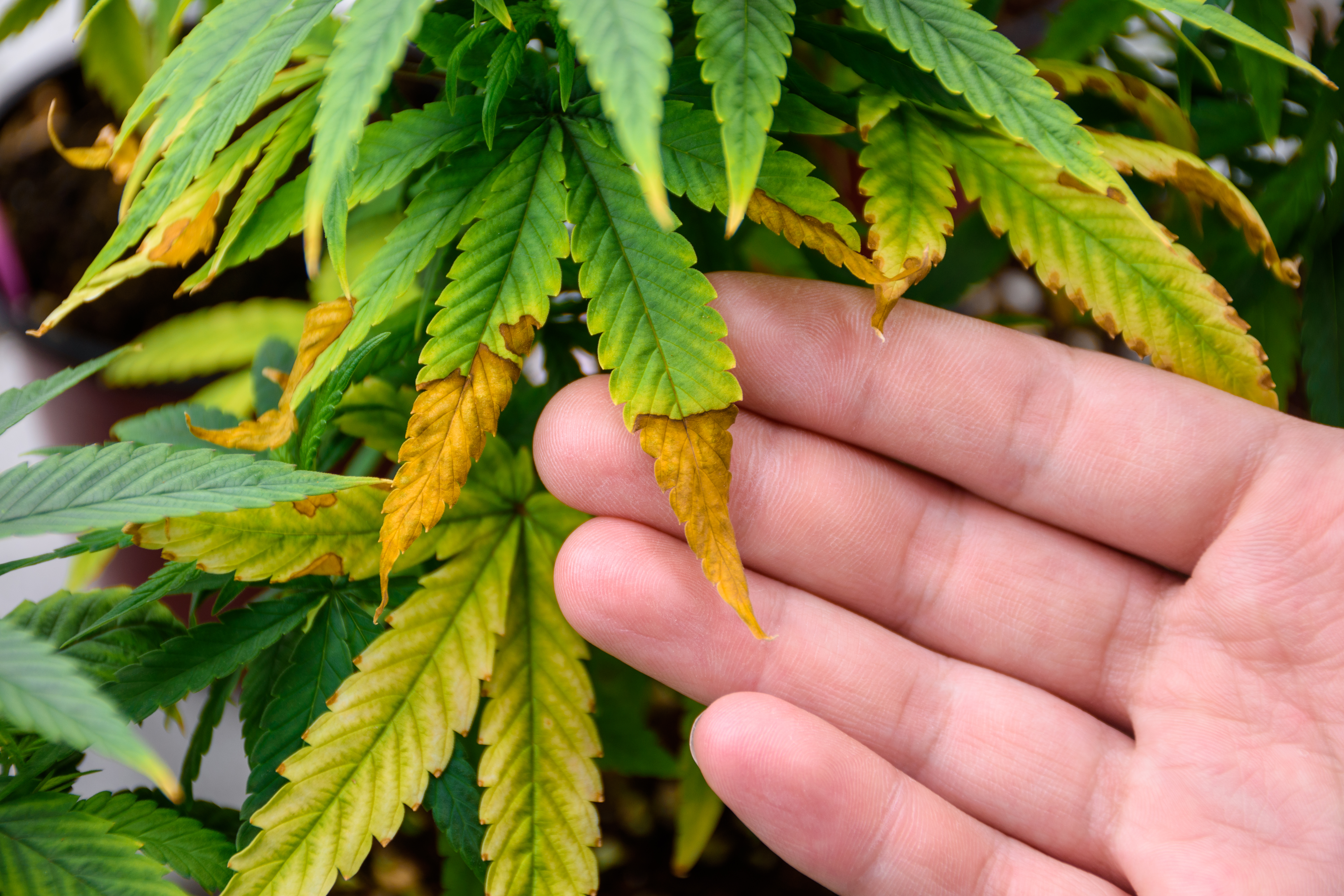


Nitrogen deficiency is one of the most common nutrient problems seen in weed plants. It can affect young plants, mature plants, indoor gardens, outdoor gardens, soil grows, coco systems, and hydroponic setups. In many cases, the first warning sign is a change in leaf color. Healthy green leaves may begin to look pale, and older leaves near the bottom of the plant may slowly turn yellow. If the problem continues, the yellowing can spread upward and affect more of the plant.
Nitrogen is one of the three main nutrients that cannabis plants need in large amounts. These three nutrients are often shown as NPK on fertilizer labels. The “N” stands for nitrogen, the “P” stands for phosphorus, and the “K” stands for potassium. Each nutrient supports different plant functions. Nitrogen is especially important for green leaf growth, strong stems, healthy branches, and the development of new plant tissue.
A cannabis plant uses nitrogen to produce chlorophyll. Chlorophyll is the green material inside leaves that helps the plant collect light. The plant uses this light to make energy through photosynthesis. When a plant does not receive enough nitrogen, it may produce less chlorophyll. This is why nitrogen-deficient leaves often lose their deep green color and become pale or yellow.
Nitrogen also helps the plant produce proteins, amino acids, enzymes, and other materials needed for growth. These substances support the building of new cells. They also help the plant repair damage and continue normal development. Without enough nitrogen, growth can become slow and weak. New shoots may remain small, stems may become thin, and the plant may lose some of its normal strength.
Nitrogen is most important during the vegetative stage. This is the stage when cannabis plants focus on producing leaves, roots, stems, and branches. A strong vegetative stage helps create the structure that will later support flowers. Plants that do not receive enough nitrogen during this time may remain smaller than expected. They may produce fewer branches and less leaf growth. This can limit the size of the plant before flowering begins.
However, yellow leaves do not always mean that the grower should add more nitrogen. This is an important point because several different problems can create similar signs. A plant may have enough nitrogen in its soil or nutrient solution but still be unable to absorb it. This situation is often called nutrient lockout.
Nutrient lockout can happen when the pH around the roots is too high or too low. The pH level affects how easily the plant can take in nutrients. When the root-zone pH moves outside a suitable range, nitrogen and other nutrients may become harder for the roots to absorb. Adding more fertilizer may not fix the problem. In fact, it may create a buildup of unused nutrients around the roots.
Root damage can also lead to signs that look like nitrogen deficiency. Roots need water, oxygen, and a suitable environment to work well. If the growing medium stays wet for too long, the roots may not receive enough oxygen. This can weaken the root system and reduce nutrient uptake. Root rot, compacted soil, high reservoir temperatures, and poor drainage can cause similar problems.
Watering mistakes are another common cause of yellow leaves. Overwatering can leave the root zone constantly soaked and low in oxygen. Underwatering can dry the roots and stop normal nutrient movement. A plant that receives too much or too little water may droop, grow slowly, and lose healthy leaf color. These symptoms can be mistaken for a simple lack of nitrogen.
Environmental stress may also reduce the plant’s ability to use nutrients. Very cold temperatures can slow root activity. Heat stress can increase water loss and weaken the plant. A recent transplant may temporarily disturb the roots. Poor lighting, pest damage, and disease may also affect plant health. For this reason, growers should look at the full growing environment before deciding that nitrogen is the only problem.
The growth stage of the plant also matters. Some yellowing of older leaves can be normal late in the flowering stage. As the plant reaches the end of its life cycle, it may move stored nutrients from old leaves to flowers and newer tissue. This natural process is sometimes called fading. It should not always be treated as a serious deficiency.
In contrast, fast yellowing during the vegetative stage or early flowering may require closer attention. A plant that is losing many lower leaves, growing slowly, or becoming weak may have a real nutrient issue. The grower should check the plant’s feeding plan, pH, watering routine, drainage, root condition, and environment.
Nitrogen deficiency in weed plants is usually easier to manage when it is found early. The first step is to identify the pattern of symptoms. The next step is to find the true cause. Treatment may involve adjusting the pH, improving drainage, correcting watering habits, repairing root-zone conditions, or using a suitable nitrogen fertilizer. Prevention depends on regular plant checks, balanced feeding, stable growing conditions, and healthy roots.
Understanding nitrogen deficiency is not only about recognizing yellow leaves. It is about learning how the plant grows and how roots, water, nutrients, pH, and the environment work together. A careful diagnosis can help growers correct the problem without overfeeding the plant or causing new damage.
Why Cannabis Plants Need Nitrogen
Nitrogen is one of the most important nutrients for cannabis plants. It is part of the three main nutrients shown on fertilizer labels as NPK. The letter N stands for nitrogen, P stands for phosphorus, and K stands for potassium. Cannabis plants need all three, but nitrogen is especially important during the vegetative stage. This is the period when the plant develops most of its leaves, branches, stems, and roots.
A cannabis plant cannot grow well without enough nitrogen. Nitrogen helps the plant create chlorophyll, produce proteins, form enzymes, and build new plant tissue. It also supports the fast growth that often takes place before flowering begins. When nitrogen levels are too low, the plant may lose its green color, grow slowly, and drop older leaves.
Nitrogen needs change as the plant moves through its life cycle. Young seedlings need only small amounts because their root systems are still developing. Plants in active vegetative growth usually need more nitrogen because they are producing large amounts of green tissue. Once flowering begins, nitrogen needs often decrease, although the plant still requires some nitrogen to stay healthy.
Understanding why cannabis needs nitrogen can help growers recognize problems early. It can also prevent unnecessary feeding. Adding too much nitrogen can be harmful, so the goal is not to provide the highest amount possible. The goal is to provide enough nitrogen for the plant’s current stage and growing conditions.
Nitrogen’s Role in Chlorophyll Production
Chlorophyll is the green pigment found inside plant leaves. It absorbs light and helps the cannabis plant perform photosynthesis. Photosynthesis is the process the plant uses to turn light, water, and carbon dioxide into energy. This energy supports nearly every part of plant growth.
Nitrogen is a major part of the chlorophyll molecule. Without enough nitrogen, the plant cannot maintain normal chlorophyll levels. As chlorophyll decreases, the leaves begin to lose their rich green color. They may first become pale green and then turn yellow.
This yellowing is known as chlorosis. In a true nitrogen deficiency, chlorosis usually begins on older leaves near the bottom of the plant. These leaves may fade evenly instead of developing random spots or yellow edges. As the problem becomes worse, yellowing may spread toward the middle and upper parts of the plant.
Lower chlorophyll levels reduce the plant’s ability to capture light. This means the plant produces less energy through photosynthesis. When less energy is available, growth can slow down. The plant may produce smaller leaves, thinner stems, and fewer strong branches.
Healthy chlorophyll production is especially important during the vegetative stage. During this stage, cannabis plants often grow quickly and form a large canopy. A strong canopy allows the plant to collect more light. This supports future development and can help the plant enter the flowering stage in better condition.
However, green leaves do not always mean the nitrogen level is perfect. Leaves that are unusually dark green can sometimes point to excessive nitrogen. They may also look shiny or curl downward at the tips. A healthy plant should have a natural green color that fits its variety, age, and stage of growth.
Nitrogen and Vegetative Growth
The vegetative stage is the main period of leaf, stem, and branch development. During this stage, the cannabis plant builds the structure that will later support flowers. Nitrogen plays a central role in this process because it helps create amino acids and proteins.
Amino acids are small compounds that plants use to build proteins. Proteins are needed for cell development, tissue growth, and many chemical processes inside the plant. Nitrogen is also used to make important enzymes. Enzymes help control how the plant uses nutrients, creates energy, and responds to its environment.
When enough nitrogen is available, a vegetative cannabis plant can produce broad leaves, strong shoots, and steady new growth. Healthy leaves allow the plant to collect light, while sturdy branches provide support as the plant becomes larger. Strong growth during vegetation can help prepare the plant for flowering.
A plant with too little nitrogen may appear thin or weak. New growth may develop more slowly than expected. Leaves may remain small, and the spaces between branches may change. Stems can become thin because the plant does not have enough resources to build strong tissue.
Nitrogen also supports root development, although roots need a balanced supply of other nutrients as well. Healthy roots absorb water and minerals from the growing medium. If the plant is growing quickly above the soil, it must also have enough root activity to support that growth.
The plant’s need for nitrogen does not remain the same at all times. A small seedling can be damaged by a strong fertilizer that would be suitable for a mature vegetative plant. Seedlings often receive some nutrition from their stored seed reserves and may need only a gentle nutrient supply at first.
As the plant becomes larger, its nitrogen demand may increase. Fast-growing cannabis plants can use the available nitrogen in small pots or lightly amended soil more quickly. This is one reason lower leaves may begin to fade if the feeding plan does not match the plant’s growth rate.
During flowering, growers often reduce nitrogen and increase the focus on other nutrients. However, removing nitrogen completely can cause early and severe yellowing. Flowering cannabis plants still need nitrogen for basic plant functions, especially during the first part of bloom. The amount should be balanced rather than suddenly eliminated.
Nitrogen as a Mobile Nutrient
Nitrogen is known as a mobile nutrient. This means the cannabis plant can move stored nitrogen from one part of the plant to another. When the roots cannot supply enough nitrogen, the plant often takes nitrogen from its oldest leaves and sends it toward younger leaves and active growing points.
This process explains why nitrogen deficiency normally begins near the bottom of the plant. The older fan leaves act as stored nutrient sources. The plant breaks down some of the chlorophyll and other nitrogen-containing compounds inside these leaves. It then moves the nitrogen to newer tissue where it is more urgently needed.
At first, one or two lower leaves may become pale. If the shortage continues, more lower leaves will turn yellow. They may begin to droop, dry out, and fall from the plant. The yellowing then moves upward as the plant uses nitrogen stored in the next group of leaves.
This pattern helps separate nitrogen deficiency from problems involving nutrients that cannot move easily through the plant. Deficiencies in less mobile nutrients may appear first in new leaves because the plant cannot transfer enough of the nutrient from older tissue.
The location of symptoms is helpful, but it should not be the only part of the diagnosis. Lower leaves can also turn yellow because of poor light exposure, overwatering, root problems, incorrect pH, or natural aging. A grower should consider the full pattern, the plant’s growth stage, and recent care before adding fertilizer.
Nitrogen mobility also explains why old yellow leaves may not turn green again after treatment. Once a large amount of chlorophyll has been broken down and the leaf tissue has been damaged, the plant may not repair that leaf. Recovery is better judged by new growth. If new leaves appear healthy and the yellowing stops spreading, the treatment may be working.
Removing every yellow leaf immediately is not always necessary. A leaf that is still partly green may continue to collect light and provide stored nutrients. A fully dry or dead leaf can usually be removed carefully because it no longer supports the plant. Growers should avoid removing too many leaves at once, since this can add stress.
Nitrogen is essential for healthy cannabis growth because it supports chlorophyll, photosynthesis, proteins, enzymes, leaves, branches, and stems. It is most important during the vegetative stage, when the plant is building its main structure. A shortage of nitrogen can reduce chlorophyll, causing lower leaves to fade from green to yellow. Growth may also become slower and weaker.
Because nitrogen is a mobile nutrient, the cannabis plant can move it from old leaves to new growth. This is why deficiency symptoms often begin on the oldest leaves at the bottom of the plant. Understanding this pattern helps growers identify possible nitrogen problems, but other causes of yellowing must also be checked. The best results come from providing a balanced amount of nitrogen that matches the plant’s age, growth stage, and growing environment.
Early Signs of Nitrogen Deficiency in Cannabis
Nitrogen deficiency often begins with small changes that are easy to miss. A cannabis plant may still look healthy from a distance, even while its lower leaves are starting to lose color. Because nitrogen is a mobile nutrient, the plant can move it from older leaves into newer growth. This helps protect the young leaves for a short time, but it causes the oldest leaves to show symptoms first.
Early detection is important because nitrogen supports photosynthesis, leaf growth, stem development, and overall plant strength. When the plant does not have enough usable nitrogen, growth can slow down before severe damage appears. Growers should inspect the lower part of the plant often, especially during the vegetative stage when nitrogen demand is high.
Yellowing of Lower Leaves
The most common early sign of nitrogen deficiency is yellowing on the oldest leaves near the bottom of the plant. These lower leaves may first change from dark green to light green. Over time, they can become pale yellow and then fully yellow.
The color change often spreads across the whole leaf in a fairly even way. This is different from some other nutrient problems that cause spots, stripes, or yellow areas between green veins. With nitrogen deficiency, the entire leaf surface usually loses its green color.
The yellowing starts at the bottom because the plant moves nitrogen from older leaves to newer parts. The plant is trying to protect fresh growth, since young leaves and shoots are important for continued development. As the plant removes nitrogen from the lower leaves, those leaves lose chlorophyll. Chlorophyll is the green material that helps the plant absorb light and make energy.
At first, only one or two lower leaves may look pale. If the deficiency continues, more leaves may become yellow. The problem can slowly move upward through the plant. Leaves in the middle section may begin to fade while the newest growth remains green for a longer period.
Growers should remember that one yellow lower leaf does not always mean the plant has a nitrogen deficiency. Older leaves can sometimes yellow because of low light, natural aging, root stress, or watering problems. The pattern matters. Nitrogen deficiency usually affects several older leaves and continues to spread if the cause is not corrected.
The speed of yellowing can also provide useful information. A mild deficiency may develop slowly over several days or weeks. A serious problem may cause rapid color loss across many lower leaves. Sudden yellowing may also point to root damage, incorrect pH, or another condition that blocks nutrient uptake.
Slow and Weak Growth
Nitrogen deficiency can affect plant growth before leaf damage becomes severe. A plant with too little nitrogen may grow more slowly than expected. New leaves may appear smaller, and the distance between growth points may remain short because the plant does not have enough resources to build healthy tissue.
Nitrogen is needed to form proteins, enzymes, and other materials used in plant development. Without enough nitrogen, the plant cannot produce new cells at a normal rate. This can lead to weak branches, thin stems, and a small canopy.
During the vegetative stage, cannabis plants often grow quickly and produce many new leaves and branches. This stage usually requires a steady supply of nitrogen. When nitrogen becomes limited, the plant may stop expanding as fast. Side branches may remain short, and new shoots may look weak or underdeveloped.
A nitrogen-deficient plant may also have fewer large fan leaves. Fan leaves collect light and help power plant growth. If these leaves are small or yellow, the plant may produce less energy through photosynthesis. This can create a cycle in which poor nutrition causes weaker leaves, and weaker leaves reduce the plant’s ability to grow.
Thin stems can be another early warning sign. Healthy stems should be firm enough to support leaves and future flowers. A plant that lacks nitrogen may form softer or weaker stems. These stems may bend more easily and may not support heavy growth later in the cycle.
Slow growth can be difficult to judge without a comparison. Growers can use photos, measurements, or notes to track plant development over time. If a plant has shown little change for several days while environmental conditions appear stable, nutrition should be reviewed.
However, slow growth does not prove that nitrogen is the only problem. Low temperatures, weak lighting, compacted soil, overwatering, root disease, and incorrect pH can also limit growth. The best diagnosis comes from looking at several signs together. Slow growth combined with even yellowing on older lower leaves strongly suggests a nitrogen problem.
Changes in Leaf Position and Texture
As nitrogen deficiency develops, affected leaves may change their position and texture. Lower leaves may begin to droop, even when the growing medium contains enough moisture. They may hang downward because the leaf tissue is becoming weak and losing its ability to function.
The leaves can also feel thinner or softer during the early stages. As the deficiency becomes worse, the tissue may become dry and fragile. Yellow leaves may curl downward, develop brown areas, or feel crisp around the edges.
Drying often begins after much of the green color has disappeared. Once a leaf has lost a large amount of chlorophyll and stored nitrogen, it cannot continue normal photosynthesis. The plant may then allow the leaf to die because it is no longer useful.
Affected leaves may fall from the plant with little force. In some cases, they detach on their own. This leaf loss reduces the amount of surface area available to collect light. If many leaves fall, the plant may become weaker and less able to recover.
The position of the damaged leaves is important. Nitrogen deficiency usually begins with older leaves, while the top growth remains healthier at first. If the newest leaves are yellow, twisted, or damaged before the lower leaves, another nutrient issue may be involved.
Leaf texture can also help separate nitrogen deficiency from overwatering. Overwatered leaves may look swollen, heavy, or consistently droopy across the whole plant. Nitrogen-deficient leaves are more likely to become pale, thin, dry, and weak over time.
Growers should check whether the yellowing and drooping continue to move upward. If the problem remains untreated, the plant will keep moving nitrogen from older tissue into younger growth. This means the middle leaves may eventually begin to fade. Severe deficiency can reach the upper canopy and greatly reduce plant health.
The early signs of nitrogen deficiency usually appear on the oldest leaves near the bottom of the cannabis plant. These leaves often fade from green to pale green and then yellow. The yellowing is normally even across the leaf instead of forming spots or stripes.
The plant may also grow more slowly, produce smaller leaves, and develop thin stems or weak branches. As the problem continues, lower leaves can droop, dry out, curl, and fall from the plant.
A single yellow leaf does not always confirm nitrogen deficiency. Growers should look for a clear pattern that begins in older growth and slowly moves upward. They should also consider plant age, watering habits, root health, pH, and recent feeding. Finding the problem early makes it easier to correct before the plant loses too many healthy leaves or suffers long-term growth problems.
Advanced Nitrogen Deficiency Symptoms
Nitrogen deficiency often begins with a few pale or yellow leaves near the bottom of a cannabis plant. At this early stage, the plant may still look healthy overall. However, the problem can become more serious when it is not corrected. Advanced nitrogen deficiency affects a larger part of the plant and can slow growth, weaken stems, and reduce the plant’s ability to support flower production.
Nitrogen is a mobile nutrient. This means the plant can move nitrogen from older leaves to newer growth. When the roots cannot take in enough nitrogen, the plant uses the nitrogen stored in its lower leaves. This is why the oldest leaves usually turn yellow first. As the shortage continues, the plant removes nitrogen from more leaves, and the symptoms move upward.
Advanced symptoms should not be ignored. A small number of yellow lower leaves may be normal in some cases, especially late in flowering. However, fast yellowing, dry leaves, weak growth, and widespread leaf loss can show that the plant is under serious stress.
Widespread Leaf Yellowing
One of the clearest signs of advanced nitrogen deficiency is widespread yellowing. The problem may start on one or two lower fan leaves, but it can spread through the lower half of the plant. If the shortage continues, leaves in the middle and upper parts may also lose their green color.
The yellowing caused by nitrogen deficiency is often even across the leaf. The whole leaf may slowly change from deep green to light green, pale yellow, and then bright yellow. This is different from some other nutrient problems that cause spots, burnt edges, or yellow areas between green veins.
The plant loses its green color because it cannot produce enough chlorophyll. Chlorophyll is the green material that helps plants capture light. It is needed for photosynthesis, which is the process plants use to turn light into energy. When chlorophyll levels fall, the plant cannot make energy as well as it should.
Widespread yellowing may also make the canopy look thin and weak. Leaves may become smaller, softer, or less active. The plant may stop producing healthy new leaves at its normal rate. New growth may still appear green at first because the plant sends its remaining nitrogen to the newest parts. However, severe deficiency can eventually affect the whole plant.
Growers should pay attention to how quickly the yellowing spreads. Slow yellowing of a few old leaves late in flowering may be part of the plant’s natural aging process. Yellowing that spreads over several days during vegetative growth is more likely to be a serious problem.
Brown, Dry, and Dying Leaves
As nitrogen deficiency becomes worse, yellow leaves may begin to dry out. The leaf tissue can turn brown, feel crisp, and become easy to break. The damage often starts after the leaf has been yellow for some time.
A badly damaged leaf cannot carry out normal photosynthesis. It may hang downward, curl, or develop dry areas. The leaf stem may weaken, causing the leaf to fall from the plant. In severe cases, many lower leaves may die within a short period.
Brown and dry leaves do not always mean nitrogen deficiency. Other issues, such as nutrient burn, heat stress, root damage, and low humidity, can also cause dry tissue. This is why the full pattern of symptoms is important. Nitrogen deficiency usually begins with smooth, even yellowing on older leaves before the tissue becomes brown and dry.
Dead leaf tissue will not return to green after treatment. Once a leaf is fully dry or damaged, the plant cannot repair it. Treatment should be judged by the condition of new growth and by whether the yellowing stops spreading.
Growers should also avoid removing every yellow leaf at once. A plant may still draw small amounts of nutrients from a fading leaf. Leaves that are fully brown, dry, or falling away can be removed carefully. However, removing too many leaves can place more stress on a weak plant.
Stunted Plant Development
Advanced nitrogen deficiency can greatly slow plant growth. Cannabis needs nitrogen to build leaves, stems, proteins, and other important plant tissues. When nitrogen is limited, the plant cannot continue normal development.
A deficient plant may stay short and produce fewer branches. New shoots may grow slowly, and the distance between nodes may become smaller. Stems can remain thin and may not be strong enough to support a large canopy. Leaves may also be smaller than expected.
During the vegetative stage, this lack of growth can be easy to notice. A healthy cannabis plant often produces new leaves and branches quickly under good conditions. A plant with advanced nitrogen deficiency may seem to stop growing, even when it receives enough light and water.
Stunted development can also make the plant more sensitive to other forms of stress. Weak plants may have more trouble recovering from pruning, transplanting, heat, or pest damage. Poor growth above the soil may also point to weak root activity below the soil.
It is important to check the root zone before adding more nitrogen. Compacted soil, overwatering, root rot, cold conditions, and incorrect pH can prevent the roots from absorbing nutrients. In these cases, adding more fertilizer may not solve the problem. The cause of poor nutrient uptake must also be corrected.
Possible Effects on Yield
Severe nitrogen deficiency can reduce the final yield of a cannabis plant. The level of damage depends on when the deficiency happens, how long it lasts, and how quickly the plant receives proper care.
A serious shortage during vegetative growth can limit the size of the plant. Smaller plants often produce fewer flowering sites. Thin branches may also have trouble holding large flowers. If the plant enters flowering in a weak condition, it may not have enough healthy leaf area to support strong development.
Nitrogen deficiency during early flowering can also create problems. Cannabis plants still need some nitrogen during this stage, although the amount is often lower than during vegetative growth. If nitrogen is reduced too early or too sharply, the plant may lose leaves before flowering is complete.
Leaves act like energy-producing panels. They use light to make sugars that support growth and flower development. When a large number of leaves turn yellow and die, the plant loses part of its ability to make energy. This can lead to smaller flowers and slower development.
However, growers should not respond by applying a very strong dose of nitrogen. Too much nitrogen can cause dark green leaves, downward-curving leaf tips, weak stems, and poor flower development. It may also delay maturity. The goal is to restore a balanced nutrient level, not to force rapid growth.
Yield loss cannot be predicted with one exact number. A mild problem that is corrected early may have little effect. A long-lasting deficiency that causes major leaf loss may have a much larger effect.
Can Advanced Nitrogen Deficiency Kill a Cannabis Plant?
Nitrogen deficiency alone does not always kill a cannabis plant. Many plants can survive a mild or moderate shortage, especially when it is found and corrected early. However, a severe and long-term deficiency can make the plant extremely weak.
When the plant loses too many leaves, it cannot produce enough energy. Growth may stop, stems may weaken, and the plant may no longer support normal development. If the nitrogen problem is combined with root disease, poor watering, pests, or extreme temperatures, the risk of plant death becomes greater.
Young plants may be more sensitive because they have fewer stored nutrients and less leaf area. Large plants may survive longer, but they can still suffer major damage if the shortage continues.
The best approach is to act before the plant reaches this stage. Regular checks of lower leaves can help growers notice the first signs. Early treatment is usually easier and safer than trying to save a plant with severe leaf loss.
Advanced nitrogen deficiency causes more than a few yellow leaves. Yellowing can spread from the lower canopy to the middle and upper parts of the plant. Damaged leaves may become brown, dry, and unable to recover. Plant growth can slow, stems can remain weak, and leaf loss can reduce the plant’s ability to produce energy.
A serious deficiency may also reduce yield by limiting plant size, branch strength, and healthy leaf area. Although nitrogen deficiency may not kill a plant by itself, a severe case can weaken the plant and make other problems more dangerous.
Growers should watch how symptoms develop and check the full growing environment before adding fertilizer. The plant’s growth stage, root health, watering habits, pH, and feeding schedule should all be reviewed. Correcting the cause early gives the plant the best chance to return to healthy growth.
Nitrogen Deficiency or Another Plant Problem?
Yellow leaves are one of the most common warning signs in cannabis plants. However, yellowing does not always mean the plant needs more nitrogen. Many nutrient problems, watering mistakes, root issues, and natural growth changes can cause similar symptoms. Adding nitrogen without checking the real cause may make the problem worse.
A true nitrogen deficiency usually begins on the oldest fan leaves near the bottom of the plant. The affected leaves often lose their green color in an even pattern. They may first turn pale green, then yellow, and later become dry or brown. Because nitrogen is a mobile nutrient, the plant can move it from old leaves to support new growth. This is why the lower leaves are normally affected before the upper leaves.
To make a correct diagnosis, growers should look at the location, color, shape, and speed of the damage. They should also consider the plant’s growth stage, recent feeding, watering habits, root condition, and growing environment.
Nitrogen Deficiency Versus Magnesium Deficiency
Nitrogen and magnesium deficiencies can both begin on older leaves. This makes them easy to confuse. However, the pattern of yellowing is usually different.
With nitrogen deficiency, most of the affected leaf loses its green color at about the same rate. The whole leaf may become pale before turning yellow. The veins often fade along with the rest of the leaf. The change normally starts on lower fan leaves and slowly moves upward if the problem continues.
Magnesium deficiency often causes interveinal yellowing. This means the tissue between the leaf veins becomes yellow while the veins remain greener. The leaf may develop a striped, marbled, or patchy appearance. Rust-colored spots may also form as the problem becomes more serious.
A nitrogen-deficient plant may also show slow overall growth, weak stems, and smaller new leaves. A magnesium-deficient plant may continue growing for a time, but the older leaves develop clear color differences between the veins and the surrounding tissue.
Growers should not assume that all lower-leaf yellowing is caused by nitrogen. Looking closely at whether the veins remain green can help separate these two problems.
Nitrogen Deficiency Versus Potassium Deficiency
Potassium deficiency can also affect older cannabis leaves, but the damage often begins around the leaf edges rather than across the entire leaf.
A nitrogen-deficient leaf usually fades in a more even way. The leaf changes from green to pale green and then yellow. In contrast, potassium deficiency may cause yellowing along the outer margins of the leaf. The edges can later turn brown, dry, or burnt.
Small brown spots may also appear on leaves affected by potassium deficiency. The leaf tips and edges may curl, while the center of the leaf stays greener for a longer period. Stems may become weak, and the plant may have trouble controlling water movement.
Potassium is important during many stages of growth, especially flowering. However, giving more potassium without checking pH and nutrient balance may not fix the issue. Like nitrogen, potassium can become unavailable because of root-zone problems.
The clearest difference is the pattern. Nitrogen deficiency tends to cause full-leaf yellowing, while potassium deficiency often causes edge burn, spotting, and damage around the leaf margins.
Nitrogen Deficiency Versus Nutrient Burn
Nutrient burn is caused by giving the plant more fertilizer than it can safely use. It can sometimes be mistaken for a deficiency because damaged leaves may become yellow or brown.
The first sign of nutrient burn is often a brown or yellow tip at the end of the leaf. The damage may begin as a very small burnt point. If the fertilizer level remains too high, the brown area can move farther inward along the edges.
Plants with too much nitrogen may also develop very dark green leaves. The foliage may look shiny or unusually thick. Leaf tips may bend downward in a claw-like shape. Growth can become weak even though the plant looks heavily fed.
This is different from nitrogen deficiency, where the leaves usually become lighter rather than darker. Nitrogen deficiency starts on older lower leaves and causes gradual, even fading. Nutrient burn often appears at the tips of many leaves across the plant.
Adding more fertilizer to a plant with nutrient burn can cause serious stress. Before feeding, growers should review the amount and strength of the nutrients already used. They should also check whether salts have built up in the growing medium.
Nitrogen Deficiency Versus Overwatering
Overwatering can cause yellow leaves, slow growth, and drooping. These symptoms may look similar to nitrogen deficiency, but the main cause is a lack of oxygen around the roots.
Cannabis roots need both water and air. When the growing medium stays wet for too long, air spaces fill with water. The roots may struggle to breathe and absorb nutrients. Even when enough nitrogen is present, the plant may act as if it is deficient.
Overwatered leaves often look heavy and droop downward. The stems may remain firm while the leaves hang. The growing medium may stay wet for several days, and the container may feel heavy. In more serious cases, the roots can become weak, brown, or affected by rot.
Nitrogen-deficient leaves may also droop, but the strongest sign is usually even yellowing that begins on older growth. The soil or growing medium may not be overly wet.
Before adding nitrogen, growers should check moisture below the surface. The top layer can look dry while the lower part of the container remains soaked. Poor drainage, oversized containers, low temperatures, and frequent watering can all keep the root zone too wet.
Correct watering practices may restore nutrient uptake without the need for a stronger fertilizer.
Nitrogen Deficiency Versus Normal Flowering Fade
Some yellowing can be normal during the later part of flowering. As the cannabis plant reaches the end of its life cycle, it may use stored nutrients from older fan leaves. These leaves can gradually turn yellow and fall away.
This natural process is sometimes called fading. It often begins on lower leaves and can look similar to nitrogen deficiency. The timing and speed of the change are important.
A slow fade near the end of flowering may not be a serious problem. The plant may still have healthy flowers and enough green leaves to continue photosynthesis. In this case, giving a large amount of nitrogen may delay maturity or affect flower quality.
However, rapid yellowing during early flowering may signal a true shortage or nutrient lockout. If many leaves become yellow within a short time, the plant may not have enough healthy foliage to support flower development. Yellowing that reaches the upper canopy too early should also be investigated.
Growers should consider how many weeks remain before harvest. They should also check whether the plant is still producing healthy green growth. Natural fading happens gradually, while a serious deficiency often spreads faster and affects plant strength.
Nitrogen deficiency has a clear pattern, but it can look similar to several other cannabis problems. It usually causes even yellowing that begins on older, lower leaves. The plant may also grow slowly and lose leaves as the condition becomes worse.
Magnesium deficiency often leaves the veins green while the areas between them turn yellow. Potassium deficiency is more likely to cause yellow or burnt leaf edges. Nutrient burn usually begins at the tips and may appear with very dark green leaves. Overwatering causes drooping and weak nutrient uptake because the roots lack oxygen. Late-flowering fade can be natural when it happens slowly near harvest.
Main Causes of Nitrogen Deficiency
Nitrogen deficiency does not always mean that a grower forgot to feed the plant. In many cases, nitrogen may be present in the soil or nutrient solution, but the roots cannot absorb it. Problems with pH, watering, drainage, roots, and temperature can all reduce nitrogen uptake. For this reason, growers should study the full growing environment before adding more fertilizer.
A correct diagnosis is important because adding extra nitrogen to a plant that cannot absorb nutrients may make the problem worse. It may lead to nutrient buildup, root damage, or nitrogen toxicity. The following causes are among the most common reasons cannabis plants develop signs of nitrogen deficiency.
Not Enough Nitrogen in the Growing Medium
A basic cause of nitrogen deficiency is a lack of available nitrogen in the growing medium. Cannabis plants use nitrogen to make chlorophyll, proteins, enzymes, leaves, and stems. Demand is often highest during the vegetative stage, when the plant is producing large amounts of green growth.
Soil can lose available nitrogen over time. This is more likely when a plant has remained in the same container for several weeks without fresh nutrients. The roots continue to absorb nitrogen, but the supply becomes smaller. Eventually, the plant begins moving nitrogen from its oldest leaves to its newest growth. This causes the lower leaves to fade from green to pale green and then yellow.
A weak feeding plan may also cause the problem. Some growers use too little fertilizer because they are afraid of nutrient burn. Caution is helpful, but very low doses may not support a fast-growing plant. A plant may also develop a shortage when feedings are missed or when a fertilizer contains very little nitrogen.
Small containers can run out of nutrients faster than large containers. A large cannabis plant growing in a small pot has many roots competing for a limited amount of soil. Water and nutrients may be used quickly. The root area may also become crowded, which can make it harder for the plant to absorb what it needs.
Organic soil can provide nitrogen, but the nutrient must become available through natural breakdown. Compost, worm castings, and other organic matter release nutrients over time. Cold conditions, dry soil, or weak microbial activity may slow this process. As a result, nitrogen may not become available fast enough to meet the plant’s needs.
Incorrect Root-Zone pH
The pH of the root zone affects how easily a cannabis plant can absorb nutrients. Even when the growing medium contains enough nitrogen, an unsuitable pH can reduce nutrient uptake. This condition is often called nutrient lockout.
Nutrient lockout does not mean that all nutrients are completely blocked. It means the roots cannot take them in at a normal rate. The plant may then show deficiency symptoms even after fertilizer has been added.
The correct pH range depends on the growing method. Soil, coco coir, and hydroponic systems do not always use the same target range. Growers should follow a suitable range for their chosen medium and test the water or nutrient solution before feeding.
It is also important to check the accuracy of the pH meter. An old or uncalibrated meter can provide false readings. A grower may believe the pH is correct when it is actually too high or too low. Testing tools should be cleaned, stored correctly, and calibrated on a regular basis.
The pH near the roots may also differ from the pH of the water going into the container. Salt buildup, old fertilizer, and changes in the growing medium can affect root-zone conditions. This is why growers should not depend only on one reading. They should also consider the plant’s symptoms, feeding history, and overall health.
Poor Root Health
Healthy roots are needed for normal nitrogen absorption. Roots take in water, oxygen, and nutrients from the growing medium. When they become damaged, the plant may show several deficiency symptoms at the same time.
Root rot is one common cause of poor nutrient uptake. It often develops when the growing medium remains wet for too long and the roots do not receive enough oxygen. Affected roots may turn brown, become soft, or develop an unpleasant smell. The plant may droop, grow slowly, and develop yellow leaves.
Compacted soil can also limit root health. Dense soil holds less air and may drain poorly. Roots have difficulty spreading through it, and water may stay around them for too long. A light, well-draining growing medium gives roots better access to oxygen.
Root damage may also occur during transplanting. If roots are torn, crushed, or exposed for too long, the plant may temporarily absorb fewer nutrients. Mild transplant stress often improves as the roots recover. However, severe damage can cause continued yellowing and slow growth.
Crowded roots can create similar problems. A root-bound plant has roots that circle the inside of the container because there is little room left. The growing medium may dry very quickly, and nutrient uptake may become uneven. Moving the plant into a larger container can help when root crowding is the main cause.
Watering and Drainage Problems
Both overwatering and underwatering can cause symptoms that look like nitrogen deficiency. Overwatering is especially common. It fills the air spaces in the growing medium with water and reduces the oxygen available to the roots.
Without enough oxygen, roots cannot work well. The plant may droop, grow slowly, and develop yellow leaves. Adding more fertilizer will not solve the main problem if the roots are still sitting in wet soil.
Underwatering can also reduce nitrogen uptake. When the growing medium becomes extremely dry, the roots cannot absorb water and dissolved nutrients. Repeated severe drying may damage fine roots and stress the plant.
Drainage should also be checked. Containers need open drainage holes, and excess water should be able to leave the root zone. Heavy or compact soil may remain wet even when the container has holes.
Too much runoff may remove nutrients from some growing media. This can happen after heavy watering, strong rainfall, or repeated flushing. Nitrogen is mobile and can be washed away more easily than some other nutrients. Outdoor plants in sandy soil may be at greater risk because water moves through the soil quickly.
A balanced watering routine is best. Growers should water based on the condition of the growing medium and the needs of the plant, rather than following a strict daily schedule.
Environmental Stress
Environmental stress can reduce nutrient uptake even when the plant has enough fertilizer. Cold conditions are a common example. Low root-zone temperatures slow root activity and reduce the plant’s ability to absorb nitrogen.
Cold soil can remain wet for longer because water evaporates more slowly. This creates a second problem by lowering oxygen levels around the roots. Cannabis plants may then show yellowing, drooping, and weak growth.
Sudden temperature changes can also stress the plant. Moving a plant from a warm indoor space to a cold outdoor area may slow nutrient uptake. The same problem can happen when containers sit directly on a cold floor.
Transplant stress, strong wind, poor lighting, and major changes in humidity can also slow growth. A stressed plant may use water and nutrients at a different rate. Growers should avoid changing several parts of the growing environment at the same time.
A plant may need a short period to adjust after transplanting or moving to a new area. During this time, it is better to keep conditions stable and avoid strong fertilizer doses.
Nitrogen deficiency can be caused by a true lack of nitrogen, but it can also result from problems that stop the roots from absorbing nutrients. Common causes include weak feeding, exhausted soil, small containers, incorrect pH, unhealthy roots, poor drainage, overwatering, underwatering, and cold conditions.
How to Confirm a Nitrogen Deficiency
Nitrogen deficiency can look similar to several other cannabis plant problems. Yellow leaves may be caused by low nitrogen, incorrect pH, damaged roots, poor watering, or another nutrient shortage. For this reason, growers should not add more fertilizer as soon as they see a yellow leaf. A careful check can help confirm whether nitrogen is the real problem.
The best way to diagnose nitrogen deficiency is to study where the symptoms began, how the yellowing looks, and how fast it is spreading. It is also important to consider the plant’s growth stage, recent feeding, root-zone pH, and watering habits. Looking at all these factors can prevent the wrong treatment and reduce the risk of nutrient burn.
Examine Where the Yellowing Started
The location of the first yellow leaves gives an important clue. Nitrogen is a mobile nutrient. This means a cannabis plant can move nitrogen from older leaves to younger parts when supplies are low. The plant sends the available nitrogen toward new shoots because these areas are still growing.
As a result, nitrogen deficiency usually begins on the oldest fan leaves near the bottom of the plant. These leaves often fade from healthy green to light green before becoming yellow. The color change is usually even across most of the leaf. It may not begin as clear spots, stripes, or burnt edges.
Growers should look closely at both sides of the plant. One damaged lower leaf does not always mean nitrogen deficiency. A leaf may turn yellow because it receives little light, touches wet soil, has physical damage, or is simply old. Nitrogen deficiency is more likely when several lower leaves show a similar pattern.
The speed of the yellowing also matters. A mild deficiency may progress slowly over several days. A serious problem may spread from the lowest leaves into the middle canopy. When the condition continues, older leaves may dry, curl, turn brown, and fall from the plant.
It can be useful to take a clear photo of the plant each day. Comparing photos makes it easier to see whether symptoms are spreading. It also helps growers judge whether treatment is working later.
Review the Plant’s Growth Stage
Cannabis plants have different nitrogen needs during different stages of growth. A plant in active vegetative growth uses a large amount of nitrogen to produce leaves, stems, and branches. Fast-growing plants may develop symptoms when their feeding plan is too weak or when the growing medium has been exhausted.
Nitrogen deficiency during the vegetative stage usually deserves quick attention. If the plant loses many healthy fan leaves, its ability to capture light and produce energy may fall. Growth may become slow, and new shoots may remain small.
Seedlings require more care. A very young plant does not need a strong nutrient solution. Yellowing in a seedling may come from overwatering, poor soil, root damage, or fertilizer that is too strong. Adding a heavy dose of nitrogen can make the problem worse. Growers should first check moisture levels and the condition of the growing medium.
The meaning of yellow leaves also changes during flowering. Cannabis plants still need nitrogen during early flowering, especially while they are stretching and building new plant tissue. However, their nitrogen demand usually becomes lower as flowering continues.
Some yellowing of old lower leaves can be normal near the end of the flowering cycle. At this point, the plant may use stored nutrients from older leaves. This is often called natural fading. Natural fading usually happens gradually and close to harvest.
Yellowing that begins early in flowering, spreads quickly, or affects much of the plant may not be normal. It may indicate a true deficiency, root-zone problem, or incorrect feeding plan. The plant’s age and stage should always be considered before deciding on treatment.
Test pH and Nutrient Strength
A growing medium may contain enough nitrogen, but the roots may not be able to absorb it. This condition is often called nutrient lockout. Incorrect root-zone pH is one of the main causes.
Growers should test the pH of the water before feeding. They should also test the nutrient solution after all products have been mixed. Nutrients can change the final pH, so testing plain water alone may not give useful information.
The correct pH range depends on the growing method. Soil, coco coir, and hydroponic systems do not always use the same target range. Growers should follow reliable guidance for their specific growing medium and nutrient products.
A pH meter should be clean and calibrated. An uncalibrated meter may give a false reading. This can lead a grower to adjust a solution that was already suitable. Liquid test kits can also be useful, although the result may be less exact.
Some growers test runoff water from the bottom of the container. Runoff may provide clues about salt buildup or changes inside the root zone. However, one runoff reading should not be treated as a complete diagnosis. The result can change based on watering amount, soil type, container size, and how evenly the pot was watered.
Electrical conductivity, also known as EC, can help measure the total amount of dissolved minerals in a nutrient solution. Total dissolved solids, or TDS, is another common measurement. A very low reading may suggest that the plant is not receiving enough nutrients. A very high reading may suggest excessive fertilizer or salt buildup.
EC and TDS cannot show exactly how much nitrogen is present. They only show the overall strength of the solution. These tools should be used together with visual symptoms, pH readings, and feeding records.
Review Recent Plant Care
Recent plant care can reveal the cause of yellowing. Growers should think about when the plant was last fed and whether the feeding strength was changed. A plant may become deficient after several water-only irrigations, especially in a low-nutrient growing medium.
The type of fertilizer also matters. Bloom fertilizers often contain less nitrogen than vegetative formulas. Switching to a bloom product too early may reduce nitrogen before the plant has finished its stretch.
Watering habits should also be checked. Constantly wet soil can reduce oxygen around the roots. Weak or damaged roots may not absorb nitrogen well, even when enough fertilizer is present. Overwatered plants may also droop while their leaves become pale or yellow.
Severe underwatering can harm roots as well. When the growing medium becomes extremely dry, nutrient uptake may slow. Repeated cycles of severe dryness and heavy watering can place the plant under stress.
Drainage is another important factor. Water should be able to leave the container freely. Compact soil, blocked drainage holes, and standing water can create unhealthy root conditions.
Growers should also consider recent transplants, cold temperatures, pest damage, or root disease. A plant may show yellow leaves after its roots have been disturbed. Cold root zones can slow nutrient absorption. Pests may damage leaves or roots and create symptoms that resemble a deficiency.
It is usually best to change one factor at a time. Making several major changes at once can create new stress and make it difficult to identify what solved the problem. Careful records of watering, feeding, pH, and plant symptoms can make diagnosis much easier.
To confirm nitrogen deficiency, begin by checking the oldest lower leaves. Nitrogen deficiency usually causes even yellowing that starts near the bottom and moves upward over time. Several leaves should show a similar pattern before the problem is treated as a true deficiency.
The plant’s growth stage must also be considered. Yellowing during active vegetative growth may require attention, while slow fading near the end of flowering may be normal. Growers should test pH, review nutrient strength, and inspect watering and drainage conditions before adding more nitrogen.
A proper diagnosis looks at the whole plant and its recent care. When yellowing location, growth stage, pH, feeding history, and root health all point toward low nitrogen, treatment can begin with greater confidence. This careful process helps prevent overfeeding and gives the plant a better chance to recover.
How to Treat Nitrogen Deficiency in Soil-Grown Cannabis
Treating nitrogen deficiency in soil-grown cannabis requires more than adding fertilizer. Yellow leaves may suggest that the plant needs nitrogen, but the true cause can also be poor pH, damaged roots, compact soil, or incorrect watering. Adding more nutrients without checking these issues can make the problem worse.
The best approach is to inspect the whole growing environment first. Once the cause is clear, the grower can correct the problem in a careful and controlled way. Treatment should help the plant return to healthy growth without causing nutrient burn or excess nitrogen.
Correct the Root-Zone Problem First
The root zone is the area of soil around the roots. This is where the plant absorbs water, oxygen, and nutrients. Even if the soil contains enough nitrogen, the plant may not be able to use it when root-zone conditions are poor.
Begin by checking the soil pH. Soil-grown cannabis can struggle to absorb nutrients when the pH is too high or too low. This problem is called nutrient lockout. During nutrient lockout, nitrogen may be present in the soil, but the roots cannot take it in at a normal rate.
Test the pH of the water and nutrient mixture before applying it. It may also help to test runoff water, although runoff readings should not be viewed alone. They should be compared with the plant’s condition, feeding history, and soil type.
Watering habits should also be reviewed. Soil that stays wet for too long can lose oxygen. Roots need oxygen to remain healthy and active. When the soil is constantly soaked, the roots may become weak or damaged. This reduces their ability to absorb nitrogen.
Overwatered cannabis plants may have yellow leaves, slow growth, and drooping stems. These symptoms can look similar to nitrogen deficiency. Before adding fertilizer, allow the soil to dry to a suitable level. Make sure the container has open drainage holes and that extra water can leave the pot.
Underwatering can also affect nutrient absorption. Very dry soil may prevent roots from taking in water and dissolved nutrients. A plant that repeatedly becomes severely dry may show weak growth and yellow leaves. Water should be applied evenly so that the root ball becomes moist without remaining soaked.
The soil should also be loose enough to allow air and water to move through it. Heavy or compacted soil can trap water and limit root growth. If the growing medium drains very slowly, improving drainage may be more important than increasing nitrogen.
Apply a Nitrogen-Containing Fertilizer
After checking the root zone, the next step is to provide nitrogen if the plant truly needs it. A complete fertilizer made for the vegetative stage is often the simplest choice. These products normally contain nitrogen, phosphorus, potassium, and smaller amounts of other nutrients.
The three main nutrient values are shown as an NPK ratio on the product label. The first number represents nitrogen. A vegetative fertilizer usually contains more nitrogen than a flowering fertilizer because cannabis plants need strong leaf and stem growth during this stage.
Follow the manufacturer’s mixing directions carefully. It is often safer to begin with a lower or moderate dose, especially if the plant is already stressed. A weak plant may not respond well to a strong feeding.
Do not double the fertilizer dose in an attempt to correct the deficiency faster. Cannabis roots can only absorb a limited amount of nutrients at one time. Extra fertilizer can create salt buildup in the soil and may burn the roots.
Nutrient burn often causes brown or yellow leaf tips. The leaves may also become very dark green and begin to curl downward. This can make diagnosis harder because the plant may show signs of both the original deficiency and excess fertilizer.
Apply the nutrient solution evenly across the soil. Avoid pouring it into only one small area of the pot. Even watering helps the solution reach more of the root system.
The plant should then be observed for several days. More fertilizer should not be added each day unless the normal feeding schedule requires it. Repeated feeding before the plant has time to respond may lead to overfertilization.
Organic Nitrogen Sources
Growers using organic soil may choose natural sources of nitrogen. Common options include compost, worm castings, fish-based fertilizer, blood meal, feather meal, and plant-based liquid feeds. Each source works at a different speed.
Worm castings are a mild source of plant nutrients and beneficial organic matter. They can be mixed into the soil or applied as a thin layer on top. Worm castings are less likely to burn roots than many concentrated fertilizers, but they may not correct a serious deficiency quickly.
Finished compost can also improve the soil. It may provide small amounts of nitrogen while supporting soil structure, water movement, and microbial life. The nutrient level in compost can vary, so it may be difficult to know exactly how much nitrogen it contains.
Fish-based liquid fertilizers often work faster than dry organic amendments. They can supply available nitrogen to plants that need a quicker response. However, they should still be measured and diluted according to the label.
Blood meal contains a high level of nitrogen. It can be useful when preparing soil, but it must be handled carefully. Too much blood meal can raise nitrogen levels beyond what the plant needs. It may also release nutrients slowly, which makes it difficult to correct mistakes.
Dry organic amendments depend on moisture, temperature, and soil microbes to break them down. For this reason, they may take several days or weeks to become available. These products are often better for long-term soil support than emergency treatment.
Organic does not always mean gentle. Concentrated organic fertilizer can still damage roots or create excess nitrogen. All products should be measured carefully.
Monitor the Plant After Treatment
After treatment, focus on the new growth. Old yellow leaves may not return to green, even when the nitrogen problem has been corrected. Once leaf tissue is badly damaged, it cannot fully repair itself.
A healthy response usually begins with the yellowing slowing down or stopping. New leaves should appear greener, stronger, and closer to a normal size. The plant may also begin growing faster.
Do not remove every yellow leaf at once. A partly green leaf can still produce energy through photosynthesis. It may also contain nutrients that the plant can move to other areas. Leaves that are fully dry, dead, or easy to remove may be taken off with clean tools.
Continue checking the lower and middle parts of the plant. If yellowing keeps moving upward, the treatment may not have solved the main cause. The grower should recheck pH, watering, soil drainage, root health, and fertilizer strength.
Avoid making several major changes at the same time. For example, changing the soil, increasing fertilizer, adjusting pH, and changing the watering schedule together can place the plant under more stress. It also makes it difficult to know which action helped.
Nitrogen deficiency in soil-grown cannabis should be treated in a careful order. First, inspect the root zone and correct problems with pH, watering, drainage, or compacted soil. Once the roots can absorb nutrients properly, apply a suitable nitrogen-containing fertilizer at a safe dose.
Organic products such as worm castings, compost, fish fertilizer, and blood meal may also provide nitrogen, but they differ in strength and release speed. Slow-release products are often better for prevention, while liquid fertilizers may work faster.
Recovery should be judged by the condition of new growth rather than old yellow leaves. When new leaves are greener and the yellowing stops spreading, the treatment is likely working. Careful observation and moderate feeding are safer than trying to force a fast recovery with a heavy dose of nitrogen.
Treating Nitrogen Deficiency in Coco and Hydroponic Systems
Nitrogen deficiency can develop quickly in coco coir and hydroponic growing systems. Unlike rich soil, these systems contain little or no stored nutrition. The plant depends on the grower to supply nutrients through the water. When the nutrient solution is weak, unbalanced, or difficult for the roots to absorb, the leaves may begin to lose their green color.
The first signs often appear on older leaves near the bottom of the plant. These leaves may turn pale green and then yellow. Growth may also slow down. However, yellow leaves do not always mean the plant needs a stronger fertilizer. Problems with pH, roots, watering, or the nutrient mixture can create similar symptoms. For this reason, the full growing system should be checked before more nitrogen is added.
Check the Nutrient Solution
The nutrient solution is the main source of nitrogen in coco and hydroponic systems. Start by checking whether the fertilizer is designed for the plant’s current growth stage. A formula made for active leaf and stem growth usually contains more nitrogen than a formula intended for later stages of plant development.
The solution should be mixed according to the product directions. Adding too little fertilizer may leave the plant without enough nitrogen. Adding too much may damage the roots and make it harder for the plant to absorb water. A strong nutrient solution can also cause leaf-tip burn, very dark foliage, or downward-curving leaves. These symptoms may be mistaken for other plant problems.
Mixing order is also important. Nutrient products should not be poured together in a concentrated form. Each part should be added to the water separately and mixed well before the next product is added. When concentrated nutrients come into direct contact, some minerals may react with each other. They can form solid particles that the roots cannot use.
Water quality may also affect the final solution. Water can contain minerals, salts, or treatment chemicals that change nutrient balance. A solution that looks correct on paper may behave differently when mixed with mineral-heavy water. Growers should therefore consider both the fertilizer and the starting water when reviewing a possible deficiency.
In reservoir-based systems, the nutrient solution can change over time. Plants remove water and nutrients at different rates. Water also evaporates, which may leave the remaining solution more concentrated. Regular checks help reveal whether the solution has become too weak, too strong, or unbalanced.
Correct pH and Nutrient Lockout
A plant may show nitrogen deficiency even when nitrogen is present in the water. This can happen because of nutrient lockout. Nutrient lockout means that the roots cannot absorb a nutrient effectively because the root-zone conditions are unsuitable.
Incorrect pH is a common cause. The acidity or alkalinity of the root zone affects the chemical form of many nutrients. When pH moves too far outside the suitable range for the system, some nutrients become harder for the roots to take in. Adding more fertilizer may not solve the problem. It may instead increase salt buildup around the roots.
The pH should be checked after all fertilizers and additives have been mixed into the water. Nutrients can change the pH, so testing plain water alone does not show the final condition of the solution. In recirculating systems, the reservoir should also be checked over time because pH may rise or fall as plants use water and nutrients.
Testing equipment should be kept clean and checked for accuracy. A meter that gives an incorrect reading can lead to repeated adjustments and unstable root conditions. Sudden or constant pH changes may place more stress on the plant. A stable environment is usually more helpful than trying to reach a perfect reading through frequent corrections.
In coco coir, the water entering the container may not always match the conditions around the roots. Old fertilizer salts can build up in the growing medium, especially when feeding and drainage are poorly managed. This buildup can change nutrient availability. It can also draw water away from the roots and cause symptoms that resemble a deficiency.
Replace or Adjust the Reservoir
When a hydroponic reservoir has become old, unbalanced, cloudy, or difficult to correct, replacing it with a fresh nutrient solution may help restore stable conditions. Fresh water and a properly mixed fertilizer provide a clearer starting point. They also reduce the uncertainty caused by repeated additions of water, nutrients, and pH-adjusting products.
Before replacing the solution, the grower should consider why the problem developed. A fresh reservoir may provide only temporary improvement if the main cause is poor oxygen, damaged roots, high water temperature, or incorrect mixing. The equipment, water movement, and root area should also be inspected.
Large and sudden increases in nutrient strength should be avoided. A plant with yellow leaves may already be stressed. Giving it a very strong solution can injure the roots and delay recovery. A careful correction is safer than trying to force the leaves to turn green quickly.
In coco, adjustments should also be gradual. The growing medium holds moisture and dissolved minerals around the roots. A sudden change in the solution can create a sharp difference between the old root-zone conditions and the new water. Steady care gives the plant time to adjust.
Once the nutrient supply has been corrected, the plant should be observed for several days. The most important sign is whether the yellowing stops spreading. New growth should begin to look healthier and greener. Old yellow leaves may not return to their original color, even when the problem has been fixed.
Observe Root Health
Healthy roots are needed for nutrient absorption. Even a well-balanced nutrient solution cannot help much when the roots are badly damaged. Root problems should therefore be checked whenever a plant continues to show deficiency symptoms after feeding.
Healthy roots are generally firm and free from slime. A bad smell, soft tissue, heavy discoloration, or a slimy coating may point to root disease. Some nutrient products can stain roots, so color alone is not always proof of damage. The grower should consider smell, texture, plant condition, and water quality together.
Roots need oxygen as well as water. In deep-water and reservoir systems, poor aeration can weaken the roots. Warm water holds less oxygen and may also support the growth of harmful microbes. Pumps, air stones, water movement, and reservoir cleanliness all affect root health.
Blocked lines, failed pumps, or low water movement can also reduce the amount of oxygen and nutrition reaching the roots. Equipment should be checked to make sure it is working as intended. Small mechanical problems can produce symptoms that appear to be caused by fertilizer.
In coco, root trouble may result from keeping the medium too wet for too long, poor drainage, compacted material, or salt buildup. The roots need both moisture and air. When the container remains waterlogged, oxygen levels fall and nutrient uptake may slow.
Damaged roots often recover more slowly than leaves. The plant may need time to form healthy new root tissue before strong top growth returns. During this period, adding more and more nitrogen is unlikely to help. Stable root conditions are more important than aggressive feeding.
Treating nitrogen deficiency in coco and hydroponic systems requires more than simply adding fertilizer. The nutrient solution, pH, water quality, reservoir condition, and root health must all be reviewed. Nitrogen may be missing from the solution, but it may also be present and unavailable because of lockout or damaged roots.
A careful correction should focus on restoring balance. The fertilizer should match the plant’s stage, the solution should be mixed properly, and the root zone should remain stable. Old or unbalanced reservoir water may need to be replaced, but sudden increases in nutrient strength should be avoided.
Recovery should be judged by new growth and by whether the yellowing stops spreading. Older damaged leaves may remain yellow. Healthy new leaves, stronger growth, and stable root conditions are better signs that the plant can once again absorb the nitrogen it needs.
Recovery Time and Signs That Treatment Is Working
Correcting a nitrogen deficiency does not make a cannabis plant recover at once. The plant needs time to absorb the available nitrogen, move it through its tissues, and use it to support new growth. Recovery speed depends on several factors, including the plant’s age, growth stage, root health, growing method, and the severity of the deficiency.
A mild nitrogen deficiency may improve within several days after the main cause has been corrected. A severe deficiency may take longer, especially if many leaves have already turned yellow or fallen from the plant. Growers should not expect damaged leaves to become fully green again. The best way to measure recovery is to watch the newest growth and check whether the yellowing has stopped spreading.
When Improvement May Appear
The first signs of improvement may appear within three to seven days after proper treatment. However, this is only a general guide. Soil-grown plants may respond more slowly because nutrients must move through the soil before the roots can absorb them. Hydroponic plants may respond faster because nutrients are delivered directly through the water.
Plant age also affects recovery time. A young plant with healthy roots may begin producing greener leaves within a few days. An older or larger plant may take longer because it has more plant tissue to support. Recovery can also be slow if the plant is under other forms of stress, such as cold temperatures, poor drainage, root damage, pests, or incorrect pH.
The severity of the deficiency is another important factor. A plant with only a few pale lower leaves may recover quickly. A plant with widespread yellowing, weak stems, slow growth, and falling leaves may need one or two weeks before clear improvement is seen. Severe cases may also cause lasting damage to the plant’s size and growth rate.
Growers should avoid adding extra fertilizer simply because the plant does not turn green within one day. Too much fertilizer can cause nutrient burn or excess nitrogen. It is safer to wait, observe the plant, and check whether the symptoms are slowing down.
Signs of Successful Treatment
One of the clearest signs of recovery is greener new growth. New leaves should appear with a healthier green color instead of looking pale or yellow. The plant may also begin growing faster as its nitrogen supply improves.
Another positive sign is that the yellowing stops moving upward. Nitrogen deficiency usually starts on the oldest leaves near the bottom of the plant. If the problem is not corrected, it slowly affects leaves higher on the plant. When treatment works, the upper leaves should remain healthy, and fewer lower leaves should become yellow.
The stems and shoots may also become stronger. A nitrogen-deficient plant often grows slowly and may produce thin stems, small leaves, and weak branches. After treatment, new shoots may begin to stretch normally, and leaf size may improve.
The plant’s overall posture can also change. Leaves may look less weak or droopy once the roots are able to take in enough water and nutrients. However, this only happens when the original cause has been correctly identified. If overwatering or root damage caused the problem, adding nitrogen alone may not improve the plant.
It is helpful to take photos every few days. Changes in leaf color and plant growth can be hard to notice when looking at the plant several times each day. Photos make it easier to compare the plant’s condition before and after treatment.
Why Old Leaves May Stay Yellow
Old yellow leaves may not return to their original green color, even after the nitrogen deficiency has been corrected. This is normal. Once a leaf loses a large amount of chlorophyll or develops dead tissue, the damage may be permanent.
A slightly pale leaf may become somewhat greener if the problem is treated early. However, a fully yellow, brown, dry, or crispy leaf is unlikely to recover. The plant may allow that leaf to dry out and fall away because it can no longer provide much energy.
Growers should focus on the condition of new leaves instead of expecting every damaged leaf to recover. Healthy new growth shows that the plant can now access enough nitrogen. If new leaves are green and growth has restarted, the treatment is probably working.
Damaged leaves should not be removed too quickly unless they are fully dead, diseased, or blocking airflow. A partly green leaf may still produce some energy for the plant. Removing many leaves at once can add more stress, especially when the plant is already weak.
When removing dead leaves, use clean hands or clean cutting tools. This reduces the risk of spreading disease. Avoid cutting healthy leaves simply to make the plant look better.
When to Recheck the Diagnosis
The diagnosis should be reviewed if the symptoms continue to spread after several days. Adding more nitrogen without checking the cause can make the problem worse.
First, check the root-zone pH. Nitrogen may be present in the growing medium but unavailable because the pH is outside the proper range. This is known as nutrient lockout. When lockout occurs, adding more fertilizer may increase salt buildup without helping the plant.
Watering habits should also be reviewed. Constantly wet soil can reduce oxygen around the roots. Weak roots cannot absorb nutrients well, even when the soil contains enough nitrogen. Allow the growing medium to dry to a suitable level before watering again, and make sure excess water can drain from the container.
The roots should be checked when possible. Healthy roots are usually firm and light in color. Dark, slimy, soft, or bad-smelling roots may point to root rot. Root problems must be corrected before the plant can recover fully.
Growers should also compare the symptoms with other nutrient problems. Magnesium deficiency, potassium deficiency, nutrient burn, heat stress, and poor lighting can all cause leaf changes. Nitrogen deficiency usually causes even yellowing that begins on older leaves. Spots, burnt edges, green veins, or damaged new growth may suggest a different issue.
The feeding strength should also be reviewed. A weak nutrient solution may not provide enough nitrogen, but an overly strong solution can damage the roots. Follow the fertilizer label and increase the dose slowly when needed. Avoid making several major changes at the same time because this makes it difficult to know which change helped or caused harm.
A cannabis plant may begin showing signs of recovery within three to seven days after a nitrogen deficiency is corrected, but serious cases can take one or two weeks or longer. Recovery depends on the plant’s age, growth stage, root health, growing method, and the amount of damage already present.
The best signs of successful treatment are greener new leaves, stronger growth, healthier shoots, and yellowing that no longer spreads upward. Old yellow or brown leaves may never become green again, so growers should judge recovery by the newest growth.
If symptoms continue, the diagnosis should be checked again. Test the pH, review watering habits, inspect the roots, and compare the symptoms with other nutrient problems. Avoid adding repeated doses of nitrogen without finding the real cause. Careful observation and small adjustments give the plant the best chance to recover without developing nutrient burn or another form of stress.
Preventing Nitrogen Deficiency Throughout the Growth Cycle
Preventing nitrogen deficiency is easier than trying to repair a weak and yellowing cannabis plant. A good prevention plan should support the plant from the seedling stage through flowering. This does not mean giving the plant large amounts of nitrogen at every stage. It means providing the right amount at the right time while keeping the roots healthy.
Nitrogen problems are not always caused by a lack of fertilizer. Poor pH, damaged roots, overwatering, and weak drainage can stop a plant from taking in nitrogen. For this reason, prevention should focus on the whole growing environment, not only the nutrient bottle.
Use a Stage-Appropriate Feeding Plan
Cannabis plants need different nutrient levels during each part of their life cycle. Seedlings need only small amounts because their roots and leaves are still developing. Strong fertilizer can burn young roots and create more problems than it solves.
Nitrogen demand rises during the vegetative stage. At this time, the plant is building stems, branches, fan leaves, and new growing points. A fertilizer made for vegetative growth usually contains a higher level of nitrogen than a flowering formula.
Growers should follow the product label and begin with a mild dose. The plant can then be watched for changes. Healthy leaves should have an even green color. New growth should appear at a steady rate, and the lower leaves should not become yellow too early.
Nitrogen demand often changes when flowering begins. The plant still needs some nitrogen, especially during the early flowering stretch, when stems and branches may continue to grow. However, the amount usually decreases as flower development becomes the main focus.
A sudden stop in nitrogen can cause the lower leaves to yellow too early. On the other hand, feeding too much nitrogen during flowering can delay flower development. A gradual change from a vegetative formula to a flowering formula is often easier on the plant than a sharp change.
Maintain a Stable Root-Zone pH
The root-zone pH controls how easily a plant can absorb nutrients. Nitrogen may be present in the soil or nutrient solution, but the plant may not be able to use it when the pH is outside a suitable range. This is called nutrient lockout.
Growers should test the pH of the water after adding nutrients. Fertilizers can change the pH, so testing plain water before mixing may not give an accurate final reading.
The growing medium should also be considered. Soil, coco coir, and hydroponic systems do not always perform best at the same pH. The correct target depends on the type of system being used.
Testing equipment must be kept clean and calibrated. A poorly maintained meter can give incorrect readings. This may lead a grower to make unnecessary changes that harm the root zone.
Large and repeated pH changes should be avoided. Roots usually perform better in a stable environment. Small changes within a healthy range are normal, but major swings can reduce nutrient uptake and stress the plant.
Support Healthy Roots
Healthy roots are needed for proper nitrogen absorption. A plant with damaged or unhealthy roots may show deficiency symptoms even when the growing medium contains enough nutrients.
The growing medium should drain well while still holding enough moisture for the plant. Dense or compacted soil can limit oxygen around the roots. Without enough oxygen, roots may become weak and less able to absorb nitrogen.
Containers should also match the plant’s size. A very small container can become crowded with roots. It may also dry out quickly and lose nutrients faster. Moving the plant into a larger container at the right time can help support continued growth.
Drainage holes should remain open. Water should not collect at the bottom of the pot for long periods. Standing water raises the risk of root rot and other root problems.
In hydroponic systems, oxygen levels and water temperature are also important. Warm, poorly oxygenated water can support harmful root conditions. Clean equipment and regular reservoir care can help protect the roots.
Improve Watering Practices
Incorrect watering is a common cause of yellow leaves. A plant that receives too much water may develop weak roots because the growing medium stays wet and contains less oxygen. This can reduce nutrient uptake and make the plant appear deficient.
Plants should not be watered only because a fixed number of days has passed. Watering should be based on the plant’s needs, the container size, the growing medium, and the environment.
The upper part of the soil can be checked for dryness before watering again. The weight of the container can also provide useful information. A dry container usually feels much lighter than a recently watered one.
Underwatering can also cause problems. When the growing medium becomes extremely dry, the roots may stop taking in nutrients. Repeated severe drying can damage fine roots and slow growth.
Heavy runoff should be managed with care. Runoff can help prevent salt buildup in some systems, but too much water may wash mobile nutrients from the root zone. The best watering method depends on the medium and feeding plan.
Watch Plants During Rapid Growth
Cannabis plants can use nitrogen quickly during periods of rapid growth. The vegetative stage and the early flowering stretch are two important times to watch.
Lower fan leaves should be inspected often. Because nitrogen is mobile, early symptoms usually appear on older leaves first. A small amount of fading may be easier to correct than widespread yellowing.
The grower should also look at the whole plant. Slow growth, weak branches, thin stems, and pale new leaves may suggest that the problem is becoming more serious.
Regular checks make it easier to notice changes before the plant loses many leaves. It is useful to inspect plants under normal white light because some grow lights can make leaf color difficult to judge.
Keep Simple Growing Records
Good records can help prevent repeated nitrogen problems. The records do not need to be complex. A notebook or simple digital file can be enough.
Growers can record watering dates, fertilizer amounts, pH readings, plant age, growth stage, and visible symptoms. It is also useful to note major changes, such as transplanting, changing the light schedule, or starting a new nutrient product.
These details make it easier to find patterns. For example, yellowing that appears after each heavy watering may point to a root-zone problem. Yellowing that begins after several weeks without feeding may suggest that the soil has lost much of its available nitrogen.
Records also help prevent accidental overfeeding. A grower may forget when the last nutrient dose was given and feed the plant again too soon. Written notes reduce this risk.
Avoid Excess Nitrogen
Preventing deficiency does not mean keeping the plant heavily fed. Too much nitrogen can be as harmful as too little.
Excess nitrogen may cause very dark green leaves, shiny foliage, weak stems, and leaf tips that bend downward. This downward curve is sometimes called clawing. Burnt leaf tips may also appear when the nutrient level becomes too strong.
Too much nitrogen during flowering may cause the plant to keep producing leaves and stems instead of focusing on flowers. It may also make the plant more sensitive to other nutrient problems.
Extra fertilizer should not be added only because one or two leaves are yellow. Older leaves can yellow for several reasons, including normal aging, watering stress, pH problems, and root damage. The cause should be checked before changing the feeding plan.
Nitrogen deficiency can often be prevented through steady care. Cannabis plants should receive a feeding plan that matches their stage of growth. They need more nitrogen during active vegetative growth and less as flowering continues.
Stable pH, healthy roots, good drainage, and careful watering are just as important as fertilizer. When these conditions are poor, a plant may not absorb the nitrogen that is already available.
Growers should inspect lower leaves, watch plants during rapid growth, and keep simple records of feeding and watering. These steps can reveal small problems before they become severe. At the same time, nitrogen should not be overused. A balanced approach supports healthy green growth without causing nutrient burn or delayed flowering.
Conclusion
Nitrogen is one of the most important nutrients for healthy cannabis growth. It supports chlorophyll production, photosynthesis, leaf development, stem growth, and the formation of new plant tissue. Cannabis plants need enough nitrogen to stay green and grow at a steady rate, especially during the vegetative stage. When nitrogen becomes unavailable, the plant cannot continue normal growth for long. It begins moving nitrogen from its older leaves to its younger growth. This is why the first signs of nitrogen deficiency often appear near the bottom of the plant.
The most common sign is even yellowing across older fan leaves. A healthy leaf may first become pale green. It may then turn yellow, dry out, and fall from the plant. As the problem becomes worse, the yellowing can move upward into the middle part of the canopy. Growth may slow, stems may become thin, and new leaves may remain smaller than expected. A severe or long-lasting deficiency can weaken the whole plant and reduce its ability to support flower production.
However, yellow leaves do not always prove that a cannabis plant needs more nitrogen. Several problems can cause similar symptoms. Overwatering can damage roots and make leaves yellow or droop. Poor drainage can reduce oxygen around the roots. Incorrect pH can prevent the plant from absorbing nitrogen, even when fertilizer is already present. Root disease, cold temperatures, compacted soil, and other nutrient problems may also lead to yellow leaves. For this reason, growers should examine the full plant and its growing conditions before adding more fertilizer.
The location and pattern of the damage can provide useful clues. Nitrogen deficiency usually starts on the oldest leaves near the bottom. The yellowing often spreads evenly across the leaf instead of forming sharp spots or burnt edges. Magnesium deficiency may also affect old leaves, but it often leaves the veins greener than the tissue between them. Potassium problems are more likely to cause yellow or brown edges. Nutrient burn usually begins at the leaf tips and may appear when the plant is already very dark green. These differences can help growers avoid choosing the wrong treatment.
The plant’s growth stage must also be considered. Cannabis normally needs more nitrogen during vegetative growth because it is producing many leaves, stems, and branches. A plant that turns yellow early in this stage may have a real nutrient problem. During late flowering, some yellowing of older leaves can be natural because nitrogen demand changes as the plant matures. Even so, fast, widespread, or early yellowing should still be checked. Growers should not assume that every color change near harvest is harmless.
Before treating the plant, it is important to check pH, watering habits, drainage, root health, and the feeding schedule. If the growing medium is too wet, adding fertilizer may make the root problem worse. If the pH is outside a suitable range, the plant may be unable to use the nitrogen that is already available. If roots are damaged by rot, heat, cold, or low oxygen, they may not absorb nutrients well. Fixing these basic problems is often the first step toward recovery.
When a true nitrogen shortage has been confirmed, the plant can be given a fertilizer that contains nitrogen. A complete vegetative fertilizer is often easier to manage than a single strong nitrogen product. The fertilizer should be mixed and applied according to the product instructions. It is usually safer to begin with a moderate dose rather than using the strongest amount. Adding too much nitrogen will not make the plant recover faster. It may cause dark green leaves, downward-curving tips, weak growth, delayed flowering, or nutrient burn.
Organic growers may use compost, worm castings, fish-based fertilizer, or other nitrogen-rich materials. Some organic sources release nutrients slowly, so they may be better for prevention than for correcting a severe deficiency quickly. Concentrated organic fertilizers can still harm plants when used in excess. The word “organic” does not mean that a product can be applied without measuring it.
Growers using coco coir or hydroponic systems should also inspect the nutrient solution. They should confirm that it contains enough nitrogen for the current growth stage. The pH, nutrient strength, reservoir condition, water temperature, and root health should all be checked. A fresh nutrient solution may help when the old mixture is unbalanced, contaminated, or incorrectly prepared. Meter accuracy is also important. A poorly calibrated pH or conductivity meter can lead to incorrect adjustments.
After treatment, the grower should watch the new growth rather than waiting for every yellow leaf to become green again. Leaves that have already lost a large amount of chlorophyll may remain yellow. Dry or dead tissue cannot repair itself. Recovery is shown when the yellowing stops spreading, new leaves appear greener, and growth becomes stronger. The plant may need several days to show clear improvement, depending on its size, root condition, environment, and the severity of the deficiency.
If the symptoms continue to spread after treatment, the diagnosis should be reviewed. Repeatedly adding nitrogen without checking other causes can create an excess and make the original problem harder to identify. It is better to change one major factor at a time when possible. This makes it easier to see which action helped the plant.
Prevention is more reliable than emergency treatment. Growers should use a feeding plan that matches each stage of growth. They should maintain a stable root-zone pH, use a well-draining growing medium, select containers that provide enough root space, and avoid keeping the soil constantly wet. Regular checks of the lower leaves can help identify early changes before the whole canopy is affected. Simple records of watering dates, fertilizer amounts, pH readings, plant stage, and visible symptoms can also prevent repeated mistakes.
In summary, nitrogen deficiency is often recognized by even yellowing that begins on older, lower leaves and slowly moves upward. The condition can slow growth and weaken the plant, but it can often be corrected when found early. The best response is not to add a large dose of fertilizer at once. Growers should first check the plant’s stage, root health, pH, watering, drainage, and feeding history. Once the true cause is known, careful treatment and steady plant care can restore healthy new growth and reduce the chance of the problem returning.
Research Citation
Anderson, S. L. P., Kjelgren, R. B., & Brym, Z. (2021). Response of essential oil hemp (Cannabis sativa L.) growth, biomass, and cannabinoid profiles to varying fertigation rates. PLOS ONE, 16(7), e0252985. https://doi.org/10.1371/journal.pone.0252985
Bevan, L., Jones, M., & Zheng, Y. (2021). Optimisation of nitrogen, phosphorus, and potassium for soilless production of Cannabis sativa in the flowering stage using response surface analysis. Frontiers in Plant Science, 12, 764103. https://doi.org/10.3389/fpls.2021.764103
Cockson, P., Landis, H., Smith, T., Hicks, K., & Whipker, B. E. (2019). Characterization of nutrient disorders of Cannabis sativa. Applied Sciences, 9(20), 4432. https://doi.org/10.3390/app9204432
Dilena, E., Close, D. C., Hunt, I., & Garland, S. M. (2023). Investigating how nitrogen nutrition and pruning impacts on CBD and THC concentration and plant biomass of Cannabis sativa. Scientific Reports, 13, 19533. https://doi.org/10.1038/s41598-023-46369-5
Kakabouki, I., Tataridas, A., Mavroeidis, A., Kousta, A., Karydogianni, S., Zisi, C., Kouneli, V., Konstantas, A., & Folina, A. (2021). Effect of fertilization with urea and inhibitors on growth, yield and CBD concentration of industrial hemp (Cannabis sativa L.). Sustainability, 13(4), 2157. https://doi.org/10.3390/su13042157
Landi, S., Berni, R., Capasso, G., Hausman, J.-F., Guerriero, G., & Esposito, S. (2019). Impact of nitrogen nutrition on Cannabis sativa: An update on the current knowledge and future prospects. International Journal of Molecular Sciences, 20(22), 5803. https://doi.org/10.3390/ijms20225803
Saloner, A., & Bernstein, N. (2020). Response of medical cannabis (Cannabis sativa L.) to nitrogen supply under long photoperiod. Frontiers in Plant Science, 11, 572293. https://doi.org/10.3389/fpls.2020.572293
Saloner, A., & Bernstein, N. (2021). Nitrogen supply affects cannabinoid and terpenoid profile in medical cannabis (Cannabis sativa L.). Industrial Crops and Products, 167, 113516. https://doi.org/10.1016/j.indcrop.2021.113516
Saloner, A., & Bernstein, N. (2022). Nitrogen source matters: High NH4/NO3 ratio reduces cannabinoids, terpenoids, and yield in medical cannabis. Frontiers in Plant Science, 13, 830224. https://doi.org/10.3389/fpls.2022.830224
Song, C., Saloner, A., Fait, A., & Bernstein, N. (2023). Nitrogen deficiency stimulates cannabinoid biosynthesis in medical cannabis plants by inducing a metabolic shift towards production of low-N metabolites. Industrial Crops and Products, 202, 116969. https://doi.org/10.1016/j.indcrop.2023.116969
Questions and Answers
Q1: What does nitrogen deficiency look like in cannabis plants?
Nitrogen deficiency usually starts with older, lower leaves turning pale green and then yellow. The yellowing often spreads upward as the problem becomes worse.
Q2: Why does nitrogen deficiency affect older cannabis leaves first?
Nitrogen is a mobile nutrient. When the plant lacks nitrogen, it moves nitrogen from older leaves to newer growth, causing the older leaves to yellow first.
Q3: What causes nitrogen deficiency in cannabis?
Common causes include low nitrogen levels in the growing medium, incorrect soil pH, overwatering, damaged roots, nutrient lockout, and poor-quality soil.
Q4: How can I fix nitrogen deficiency in cannabis?
Apply a balanced cannabis nutrient that contains nitrogen. Use a mild dose at first and make sure the soil or water pH is within the correct range.
Q5: What is the correct pH for preventing nitrogen lockout?
For soil-grown cannabis, the pH should usually be about 6.0 to 7.0. For hydroponic growing, the pH should generally remain between 5.5 and 6.5.
Q6: How quickly will a cannabis plant recover from nitrogen deficiency?
New growth may begin to look healthier within several days after treatment. Leaves that have already turned fully yellow may not return to green.
Q7: Can too much nitrogen harm cannabis plants?
Yes. Excess nitrogen can cause very dark green leaves, weak stems, downward-curving leaf tips, delayed flowering, and poor bud development.
Q8: Should cannabis plants receive nitrogen during flowering?
Cannabis plants still need some nitrogen during early flowering, but the amount should be reduced. Too much nitrogen during late flowering can affect bud quality and maturity.
Q9: Can overwatering cause signs that look like nitrogen deficiency?
Yes. Overwatering can reduce oxygen around the roots and prevent proper nutrient absorption. This may cause yellow leaves, slow growth, and drooping.
Q10: How can nitrogen deficiency be prevented in cannabis?
Use a suitable growing medium, provide balanced nutrients, maintain the correct pH, avoid overwatering, and regularly inspect the lower leaves for early yellowing.